I will soon be stepping down from my position as Vice-Chair of the IAMCR Crisis Security and Conflict Communication Working Group.
It’s been a pleasure to work with Virpi and the CRI WG over the past four years. Despite a global pandemic, these years were enormously rewarding and saw a significant growth in group membership and activity. It’s been lovely to get to know members of the WG. I’ve also seen colleagues progress their careers since 2021.
Two Vice-Chair roles are among those to be up for election this month. It’s a great opportunity to work with a diverse group of scholars interested in crisis and conflict communication.
Interested candidates should send their name, institutional position, a statement of no more than 500 words and a photograph to elections@iamcr.org by Friday 4 April, with a copy to the S/WG elections coordinator Andrea Medrado (A.Medrado@exeter.ac.uk) and to Virpi and I as current leaders of the WG.
If you have any questions about the role then I please feel free to drop me a line (paul.reilly@glasgow.ac.uk).
Deconstructing societal threats during times of deep mediatization, Routledge, 2023.
A few weeks ago we had the long overdue launch event for (De)constructing Societal Threats During Times of Deep Mediatization. Organised by the IAMCR Crisis, Security and Conflict Communication Working Group, we were delighted to be joined by three of the authors (Minos, Olivia and Gregory) for a discussion of their respective chapters. The video can be viewed below:
Recording of book launch event, 16 April 2024
Thanks to our presenters and attendees for the great debate. A description of the book is below.
De)constructing Societal Threats During Times of Deep Mediatization
This book explores how both elite and non-elite actors frame societal threats such as the refugee crisis and COVID-19 using both digital and traditional media. It also explores ways in which the framing of these issues as threatening can be challenged using these platforms.
People typically experience societal threats such as war and terrorism through the media they consume, both on and offline. Much of the research in this area to date focuses on either how political and media elites present these issues to citizens, or audience responses to these frames. This book takes a different approach by focusing on how issues such as the refugee crisis and the COVID-19 pandemic are both constructed and deconstructed in an era of hybrid media. It draws on a range of traditional and innovative research methodologies to explore how these issues are framed as ‘threats’ within deeply mediatized societies, ranging from content analysis of newspaper coverage of the Macedonian name dispute in Greece to investigating conspiratorial communities on YouTube using Systemic Functional Linguistics. In doing so, this book enriches our understanding of not only how civil and uncivil actors frame these issues, but also their impact on societal resilience towards future crises.
(De)constructing Societal Threats During Times of Deep Mediatization will be a key resource for academics, researchers, and advanced students of Communication Studies, Media Studies, Journalism, Cultural Studies, Research Methods, Sociology and Politics.
The chapters included in this book were originally published as a special issue of The Communication Review. Many thanks to our authors for their excellent contributions, which are listed below:
1. Framing the Macedonian name dispute in Greece: Nationalistic journalism and the existential threat Minos-Athanasios Karyotakis
2. The “ultimate empathy machine” as technocratic solutionism? Audience reception of the distant refugee crisis through virtual reality Zhe Xu and Mengrong Zhang
3. A systemic functional linguistics approach to analysing white supremacist and conspiratorial Ddscourse on YouTube Olivia Inwood and Michele Zappavigna
4. Internet regulation and crisis-related resilience: From Covid-19 to existential risks Gregory Asmolov
Deconstructing societal threats during times of deep mediatization, Routledge, 2023.
A reminder that we are having an online launch event for our edited volume on societal threats and mediatization next week. Details below.
Please join the authors for a launch event to mark the publication of the book ‘Deconstructing societal threats during times of deep mediatization.
This book explores how both elite and non-elite actors frame societal threats such as the refugee crisis and COVID-19 using both digital and traditional media. It also explores ways in which the framing of these issues as threatening can be challenged using these platforms.
People typically experience societal threats such as war and terrorism through the media they consume, both on and offline. Much of the research in this area to date focuses on either how political and media elites present these issues to citizens, or audience responses to these frames. This book takes a different approach by focusing on how issues such as the refugee crisis and the COVID-19 pandemic are both constructed and deconstructed in an era of hybrid media. It draws on a range of traditional and innovative research methodologies to explore how these issues are framed as ‘threats’ within deeply mediatized societies, ranging from content analysis of newspaper coverage of the Macedonian name dispute in Greece to investigating conspiratorial communities on YouTube using Systemic Functional Linguistics. In doing so, this book enriches our understanding of not only how civil and uncivil actors frame these issues, but also their impact on societal resilience towards future crises.
(De)constructing Societal Threats During Times of Deep Mediatization will be a key resource for academics, researchers, and advanced students of Communication Studies, Media Studies, Journalism, Cultural Studies, Research Methods, Sociology and Politics.
The chapters included in this book were originally published as a special issue of The Communication Review. Many thanks to our authors for their excellent contributions, which are listed below:
1. Framing the Macedonian name dispute in Greece: Nationalistic journalism and the existential threat Minos-Athanasios Karyotakis
2. The “ultimate empathy machine” as technocratic solutionism? Audience reception of the distant refugee crisis through virtual reality Zhe Xu and Mengrong Zhang
3. A systemic functional linguistics approach to analysing white supremacist and conspiratorial Ddscourse on YouTube Olivia Inwood and Michele Zappavigna
4. Internet regulation and crisis-related resilience: From Covid-19 to existential risks Gregory Asmolov
Please join the authors for a book launch event to mark the publication of the book ‘Deconstructing societal threats during times of deep mediatization’. This will be held online on 16 April (9-10:30am GMT).
This book explores how both elite and non-elite actors frame societal threats such as the refugee crisis and COVID-19 using both digital and traditional media. It also explores ways in which the framing of these issues as threatening can be challenged using these platforms.
People typically experience societal threats such as war and terrorism through the media they consume, both on and offline. Much of the research in this area to date focuses on either how political and media elites present these issues to citizens, or audience responses to these frames. This book takes a different approach by focusing on how issues such as the refugee crisis and the COVID-19 pandemic are both constructed and deconstructed in an era of hybrid media. It draws on a range of traditional and innovative research methodologies to explore how these issues are framed as ‘threats’ within deeply mediatized societies, ranging from content analysis of newspaper coverage of the Macedonian name dispute in Greece to investigating conspiratorial communities on YouTube using Systemic Functional Linguistics. In doing so, this book enriches our understanding of not only how civil and uncivil actors frame these issues, but also their impact on societal resilience towards future crises.
(De)constructing Societal Threats During Times of Deep Mediatization will be a key resource for academics, researchers, and advanced students of Communication Studies, Media Studies, Journalism, Cultural Studies, Research Methods, Sociology and Politics.
The chapters included in this book were originally published as a special issue of The Communication Review.
Many thanks to our authors for their excellent contributions, which are listed below:
1. Framing the Macedonian name dispute in Greece: Nationalistic journalism and the existential threat
Minos-Athanasios Karyotakis
2. The “ultimate empathy machine” as technocratic solutionism? Audience reception of the distant refugee crisis through virtual reality
Zhe Xu and Mengrong Zhang
3. A systemic functional linguistics approach to analysing white supremacist and conspiratorial Ddscourse on YouTube
Olivia Inwood and Michele Zappavigna
4. Internet regulation and crisis-related resilience: From Covid-19 to existential risks
Gregory Asmolov
The book can be ordered here and you can register for the online book launch here
What role do photographs and other visual media play in shaping perceptions of conflict? Do news media have a responsibility to ensure future generations ‘never forget’? How have digital platforms helped shape collective memories of traumatic events?
These were among the many issues discussed at ‘Media and Conflict Memory’, an IAMCR sponsored workshop held at the University of Glasgow in November 2023. This event brought together a diverse group of researchers to discuss the role of media in remembering conflict.
Day 1 saw the majority of papers presented remotely. Panels covered topics such as the use of X (formerly Twitter) for memory activism in Zimbabwe, how young Nigerians used Facebook to document police brutality, and Gazan citizens’ use of smartphones to share experiences of military occupation. A session dedicated to the Russian invasion of Ukraine then provided new insight into how memes and digital technologies represented a virtual battleground in the ongoing conflict.
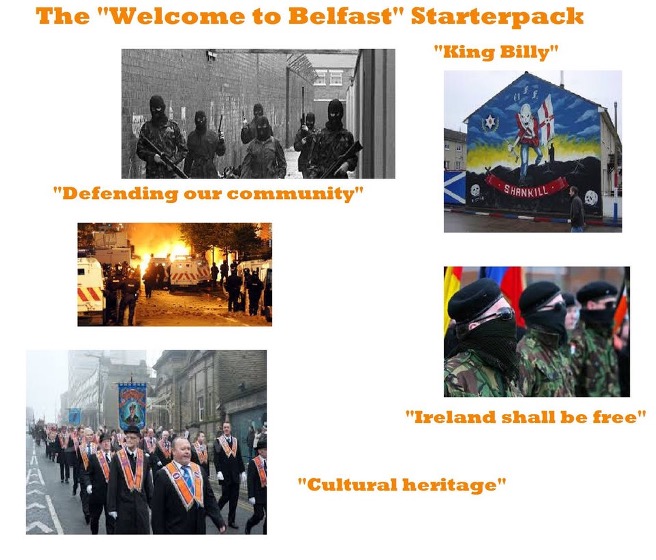
The first in-person panel focused on media representations of the Troubles in Northern Ireland. A recurring theme here was how photographs of atrocities such as Bloody Sunday had become used to support different narratives on the conflict. Context was provided on how a BBC Radio series had been developed to help bridge the competing narratives on Irish history and the origins of the Troubles. There was also evidence presented showing how popular memes were used both constructively and divisively to discuss the region’s troubled past.
Memes focussing on legacy of Troubles
We finished the day with a Q&A session about the documentary Freedom to Run featuring filmmaker Cairsti Russell and hosted by John Coster. The film focuses on two running groups, one based in Palestine and the other from Glasgow, as they participate in marathons in their respective countries. Several clips were shown illustrating the restrictions on the movement of Palestinians in the West Bank, including several unsettling scenes showing settler communities harassing and recording the running groups as they toured Hebron. The conversations afterwards focused on the experiences of the filmmakers, the challenges of documenting their experiences when faced with such repression, and the feedback received during recent screenings.
Freedom to Run
Day 2 saw the focus switch more to innovative methods of exploring conflict memory. This included how researchers used Telegram to examine Russian-Ukrainian battles over contested heritage sites, YouTube videos and collective memories of the Greek civil war, and two papers exploring colonialism and migration memory activism in Portugal. A multisensory presentation showcased how horseshoe cartography could be used to map conflict sites through film, text and collages. It was striking how many of the examples discussed in these panels were under-researched. For example, the Dersim massacre in Turkey has lived on through personal photographic archives while images of Nepti the Tiger, a British military mascot during the Malayan insurgency in the 1950s, remain long forgotten in museum archives.
Participants at Media and Conflict Memory workshop, Glasgow, November 2023
There were a few common themes from the workshop I wish to end on. First, many of the presenters reflected on their proximity to the conflicts they studied. Many felt a moral duty to provide evidence about how these were memorialised and passed down to future generations. Second, there was the lack of a fixed understanding of conflict represented in both traditional and digital media platforms. There will always be a section of the audience who choose not to agree with dominant readings of these conflict memory materials. Finally, while the digitization of conflict memory was viewed as generally positive in terms of accessibility, there were concerns that traumatic incidents were constantly relitigated and weaponised by those with no direct lived experience of them. In this respect, both traditional and digital media often highlight the lack of shared narratives on war and conflicts of the past.
Virpi Salojärvi (University of Helsinki/University of Vassa) and I are pleased to announce the publication of our co-edited book (De)constructing societal threats during times of deep mediatization today. A description of the book can be found below:
This book explores how both elite and non-elite actors frame societal threats such as the refugee crisis and COVID-19 using both digital and traditional media. It also explores ways in which the framing of these issues as threatening can be challenged using these platforms.
People typically experience societal threats such as war and terrorism through the media they consume, both on and offline. Much of the research in this area to date focuses on either how political and media elites present these issues to citizens, or audience responses to these frames. This book takes a different approach by focusing on how issues such as the refugee crisis and the COVID-19 pandemic are both constructed and deconstructed in an era of hybrid media. It draws on a range of traditional and innovative research methodologies to explore how these issues are framed as ‘threats’ within deeply mediatized societies, ranging from content analysis of newspaper coverage of the Macedonian name dispute in Greece to investigating conspiratorial communities on YouTube using Systemic Functional Linguistics. In doing so, this book enriches our understanding of not only how civil and uncivil actors frame these issues, but also their impact on societal resilience towards future crises.
(De)constructing Societal Threats During Times of Deep Mediatization will be a key resource for academics, researchers, and advanced students of Communication Studies, Media Studies, Journalism, Cultural Studies, Research Methods, Sociology and Politics.
The chapters included in this book were originally published as a special issue of The Communication Review. Many thanks to our authors for their excellent contributions, which are listed below:
1. Framing the Macedonian name dispute in Greece: Nationalistic journalism and the existential threat Minos-Athanasios Karyotakis
2. The “ultimate empathy machine” as technocratic solutionism? Audience reception of the distant refugee crisis through virtual reality Zhe Xu and Mengrong Zhang
3. A systemic functional linguistics approach to analysing white supremacist and conspiratorial Ddscourse on YouTube Olivia Inwood and Michele Zappavigna
4. Internet regulation and crisis-related resilience: From Covid-19 to existential risks Gregory Asmolov
(De)constructing societal threats during times of deep mediatization provides an introduction to a Special Issue based on research presented in the Crisis, Security and Conflict Communication working group at the conference of International Association for Media and Communication Research (IAMCR) in 2021.
We provide an overview of the literature on mediatization of conflict and crises, with a specific focus on how online platforms present both challenges and opportunities to the agenda-setting powers of mainstream media and political institutions.
The list of papers published in our Special Issue are as follows:
Minos-Athanasios Karyotakis (2022) Framing the Macedonian name dispute in Greece: nationalistic journalism and the existential threat, The Communication Review, DOI: 10.1080/10714421.2022.2129125
Zhe Xu & Mengrong Zhang (2022) The “ultimate empathy machine” as technocratic solutionism? Audience reception of the distant refugee crisis through virtual reality, The Communication Review, DOI: 10.1080/10714421.2022.2129118
Olivia Inwood & Michele Zappavigna (2022) A Systemic Functional Linguistics Approach to Analyzing White Supremacist and Conspiratorial Discourse on YouTube, The Communication Review, DOI: 10.1080/10714421.2022.2129122
Gregory Asmolov (2022) Internet regulation and crisis-related resilience: from Covid-19 to existential risks, The Communication Review, DOI: 10.1080/10714421.2022.2129124
We would like to thank all the authors, reviewers and the editorial team at TCR for their help bringing this Special Issue together.
IAMCR Crisis, Security and Conflict Communication Working Group
I have recently been elected Vice-Chair of the IAMCR Crisis, Security and Conflict Communication Working Group. Many congratulations to Virpi Salojärvi for becoming Chair of the WG, and to all the other candidates who stood during the recent elections. The results can be viewed here
Details on the WG can be found here. If you would like to get involved, please do drop me an email at p.j.reilly@sheffield.ac.uk. I look forward to working with members of the WG for the next four years.
IAMCR Crisis, Security and Conflict Communication Working Group
The International Association for Media and Communication Researchers (IAMCR) are hosting their elections for Section and Working Group Heads over the summer. I am standing as Vice-Chair for the Crisis, Security and Conflict Communication Working Group, with the (online) vote due to close on 14 September (less than two weeks to go).
Details on the WG, and how to vote, can be found here
My election statement can be found below:
I am a Senior Lecturer in Social Media & Digital Society at the University of Sheffield. My research focuses on social media sousveillance, digital activism and the use of digital media to promote better community relations in divided societies. Although I am primarily a qualitative researcher, I have also used Social Network Analysis to explore key broadcasters and gatekeepers within crisis hashtags, such as #PorteOuverte.
I have been a member of IAMCR for the past six years, presenting my work at Leicester, Cartagena, Madrid and Nairobi (virtually) as part of panels organised by the Crisis, Security and Conflict Communication Working Group at Leicester, Cartagena. I have always been particularly impressed by the diversity of the sessions organised by Rikke, Virpi and the team, which demonstrate the broad range of case studies, theoretical frameworks, and research methods in the field of crisis communication. During this time, the Working Group has excelled at facilitating collaborations between communication researchers based in countries as diverse as Australia, Chile, Nigeria and South Africa. A cursory glance at the research interests of members neatly illustrates its value as a ‘meeting point’ for scholars working in journalism studies, media and communication studies, and political communication.
If elected Vice-Chair, I would work with the Chair to promote the activities, accomplishments and publications of Group members. This would include drafting the call for papers, reviewing abstracts and organising panels for the annual conference, co-editing special issues of journals like Media, War and Conflict based on these papers, and increasing membership of the Group. My experience chairing panels at conferences e.g. ECPR, MeCCSA would also enable me to fulfil similar duties at IAMCR events. I believe it is vitally important that the diversity of the Group is consolidated, and would be happy to mentor early career researchers, particularly those from outside Europe and North America, who are new to presenting at international conferences. I would also advocate trying to increase the number of crisis communication practitioners active within the Group, perhaps as part of a seminar series in the run-up to the annual conference.
Drawing on my recent experience as Social Media and Publicity Officer for the MeCCSA Policy Network, I would prioritise building the Group’s social media presence, with a specific focus on using Twitter to curate a list of members and promote their work online. YouTube could also be used to share videos of both in-person and online seminars sponsored by the Group throughout the academic year. Finally, I would explore the possibility of creating a mailing list in order to encourage members to share updates on their research activities. My experience to date suggests that these initiatives would consolidate the identity of the group whilst also encouraging future collaborations between its members.
I am happy to answer any questions from members should they wish to contact me using the details below.






 Dr Paul Reilly