Interviewed about Trump administration’s social media activity

Photo by Markus Winkler on Pexels.com

Last Friday I spoke to Hamish Morrison of The National. We discussed the Trump administration’s use of neo-Nazi references on social media. In the past few weeks, several US agencies have posted content directly referencing white supremacist figures like Willam Gayley Simpson.

I suggested that this was both an attempt to distract from the crises facing the Trump administration and a reflection of the attitudes of those close to the president. Som quotes are below:
“It’s not coincidence, it’s not an accident. It is something which is strategic communication and they must see value in that.”

“They’re reflecting back what they see from people who are supportive of,for example, ICE’s activity in Minnesota last week [the killing of Renee Nicole Good] or the Trump administration itself” 
“It’s choosing not to talk to the entire room, talking to a very small segment of it and that could be very politically damaging for Trump.” 

I also discussed how there are contradictory reports about who is posting content on behalf of Trump. It seems that nobody is dialling down his rhetoric. This will have a very negative impact on how the Republicans fare in the midterm elections later this year.

Many thanks to Hamish for the interview, and to Charlotte Morris for arranging it. The article can be read in full here.



Invited presentation at Memory, Conflict & Peace event

Yesterday I gave an invited presentation at an event entitled ‘Memory, Conflict & Peace’. It was organised by the University of Glasgow’s Memory Lab, an interdisciplinary initiative exploring how memories are made, stored and retrieved by individuals.

Featuring a keynote by Prof. Ann Rigney (Utrecht University), the event considered how memory contributes to conflict. It addressed questions such as: How do official narratives sustain nationalism and preparedness for war? In what ways do digital media amplify, reshape, or contest memories of past violence? What can we learn from societies where memory of division remains a site of contestation?

My paper was called Random Access Memories or clichéd representations? How historical photographs of the Troubles are interpreted on Instagram. This was based on my previous article published in the journal Information, Communication & Society,

The slides can be read below.

Many thanks to the organisers (Yulia, Maria & Craig), the other speakers and attendees for such an thought-provoking workshop.

TEN presentation on MCS Independent Research Project

Yesterday, I delivered a presentation at a symposium. The symposium, Leading Curriculum and Assessment Innovation, was organised by the University of Glasgow’s Teaching Excellence Network.

My presentation was titled ‘ Is a dissertation the best way to assess international students? Developing the MCS Independent Research Project’. I discussed the challenges I faced developing and implementing the IRP over the past few years. These challenges ranged from training staff and students to the workload implications of adopting this new model.

Thanks to Julia, Honor and Errol for organising the symposium, and the other participants for their inspiring contributions.

New publication: entry in Elgar Encyclopedia  of Political Communication

Elgar Encyclopedia of Political Communication

I have an entry in the Elgar Encyclopedia of Political Communication, which was published this week.

In ‘Belief Echoes’, I explore how and why people continue to believe false information. This occurs even when the information has been debunked or fact-checked. I draw on examples from my own research on Northern Ireland and the COVID-19 pandemic. These examples show that a small proportion of the population often remain within epistemic bunkers. These bunkers revolve around misinformation and half-truths.

Many thanks to the editors (Alessandro Nai, Max Grömping, and Dominique Wirz). They worked hard to bring together the 430+ entries from 570+ authors in the Encyclopedia.

The preprint version of my entry can be read here.

Op-ed published in Scotsman on Sunday

Op-ed in Scotland on Sunday

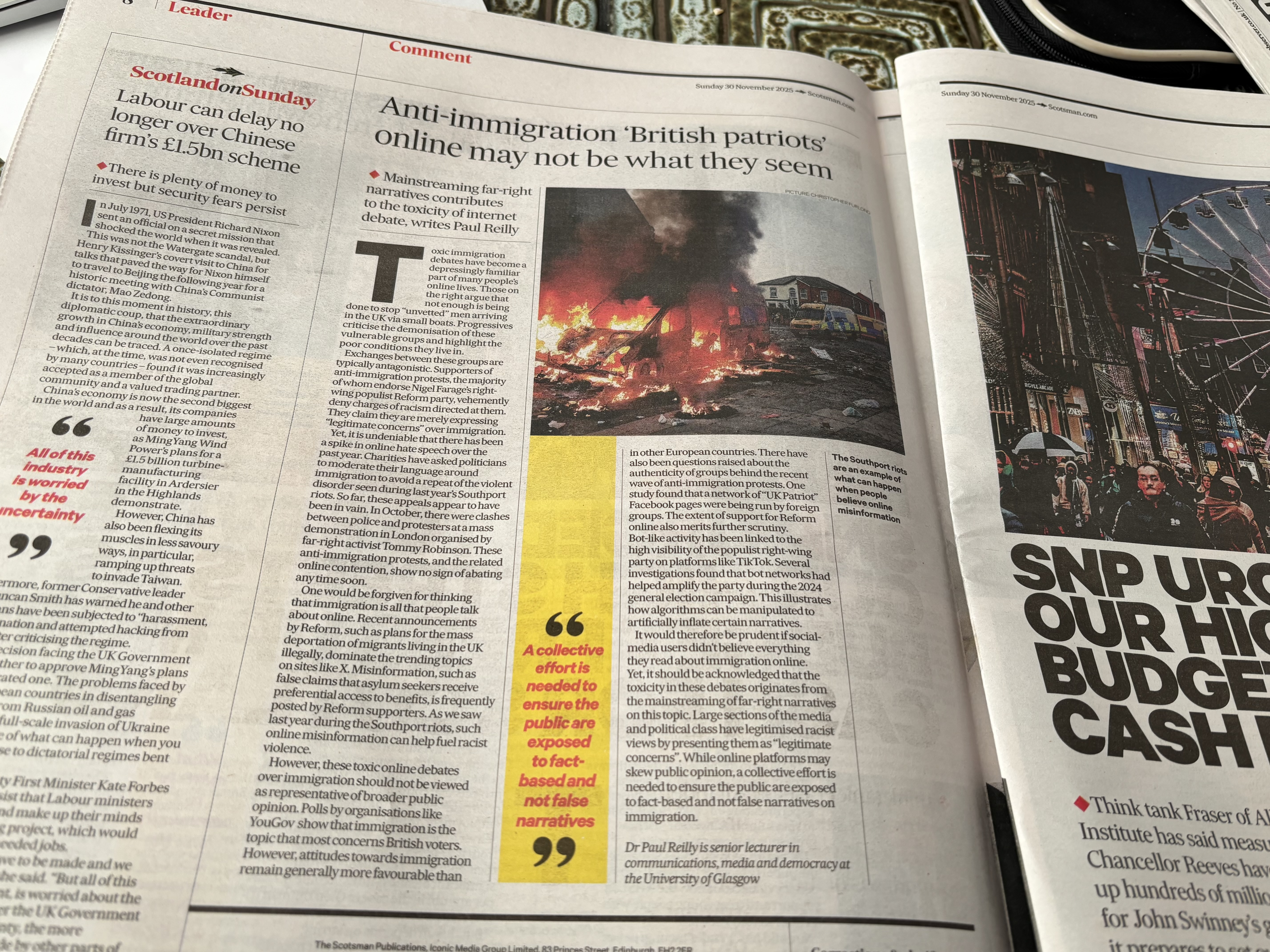
Yesterday I had an op-ed published in Scotland on Sunday. I discussed the toxic immigration debates on social media and the rise of Nigel Farage’s Reform party online. My argument was that we should be more sceptical of what we see online. There is already evidence that bots are used to amplify Reform’s talking points on this issue. The public is apparently obsessed with ‘small boats’ and ‘illegal immigration’. This is due to years of mainstreaming far-right narratives on this topic. I conclude with the argument that a collective effort is required. This effort must ensure that social media users are exposed to facts. It is essential they are not misled by false narratives on immigration.

The full text of the op-ed can be read here.

As always, many thanks to Charlotte Morris for helping arrange this. I also appreciate the editorial team at SoS for publishing it.

SPS Teaching Team Award

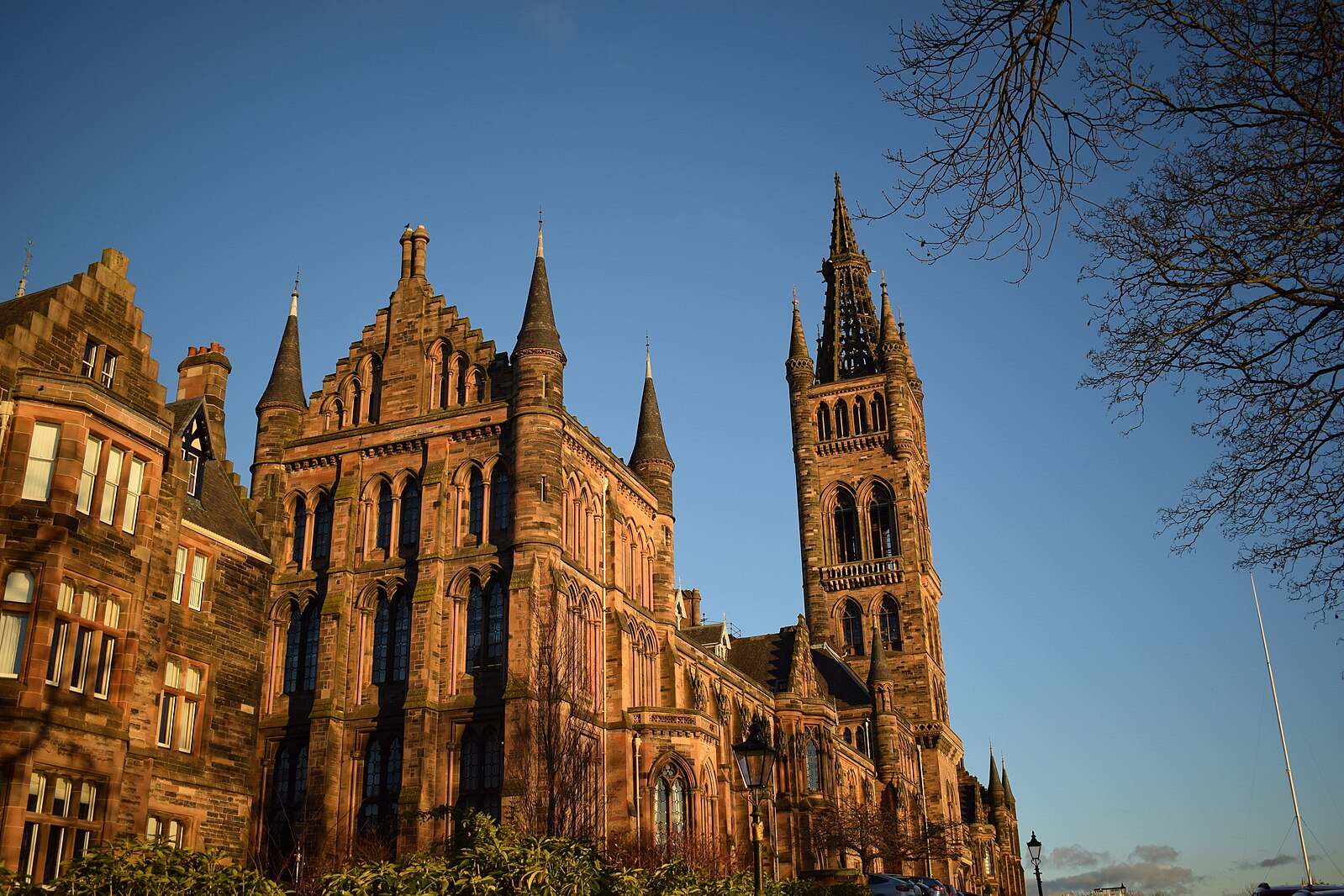
Photo by Clem_nat reproduced by Creative Commons Attribution-Share Alike 4.0 International

Yesterday I was delighted to hear that the Media Research Methods team had received the Teaching Team Award. This was part of the annual School of Social Sciences Learning & Teaching Awards. It recognises excellence in teaching at the University of Glasgow. I was one of 19 colleagues to get this the award (the full names are listed below).

The award committee noted:

“Team teaching is not new our school, but we have recently seen bigger and bigger teams coming together to develop core courses for our largest programmes. The challenge for team delivered courses is the ability to ensure coherence of experience for all students. This is something that the event winners of this award certainly achieved over the past year. Responsible for the largest single course in the school, the judging committee noted that the Media Research Methods team delivered an outstanding first run of a complex, large-scale course, driven by effective collaboration, care, and a shared commitment to over 460 students success”.

I would like to congratulate the rest of the team for all their hard work last year. I want to especially acknowledge Harvey and Lluis for their work convening this course. The full list of recipients is below- congratulations to all!:

Lluis de Nadal Alsina, Harvey Humphrey, Kirstie Ken English, Catriona Forrest, Catherine Happer, Isaac Hoff, Hayes Mabweazara, Ida Norberg, Galina Oustinova-Stjepanovic, Paul Reilly, Cairsti Russell, Lito Tsitsou, Erdem Avsar, Emma Flynn, Adnan Hossain, Caroline Leicht, Ashli Mullen, Yu Sun, Kenneth Ward

Invited presentation at event on social media and good relations in Northern Ireland

T:BUC Engagement Forum

Yesterday I was an invited speaker at a Together: Building a United Community (T:BUC) Engagement Forum event. The topic was ‘Social Media and its impact on Good Relations’.

I spoke about my ongoing research on social media, parades and protests in Northern Ireland (2012-current). I drew on the results of my book (Digital contention in a divided society), #Brexitriots study, and encyclopedia entry on belief echoes. I discussed how online platforms amplify mis-and disinformation that undermine community relations during contentious events.

My slides can be viewed below:

It was interesting to hear from the other panelists and to hear the questions and feedback from the audience.

Many thanks to Paul Killen and the NICRC for the invitation.

Presentations at MeCCSA 2025

This week I was at Edinburgh Napier University to attend the annual MeCCSA conference. The theme this year was ‘Identity and Belonging’, with a specific focus on how identities are mediated and mediate themselves.

First, I was part of a Glasgow University Media Group panel on the Cost of Living Crisis. I presented an overview of the key findings with Cairsti Russell and Gavin Hawkton (unfortunately Catherine Happer was unable to join us due to ill-health).

Key themes included the debate over the use of the word ‘crisis’. There was also a focus on the impact of austerity and cuts in public services on low-income households. Our results suggest that media coverage of the COLC prioritised business perspectives over those of civil society. Citizens are increasingly attracted to alternative news sources. The slides from the session can be viewed below:

These findings are from the GUMG’s forthcoming book ‘Bad News for the Cost of Living Crisis’. The book, edited by Catherine Happer, Alison Eldridge and me, will be published with Palgrave Pivot in December 2025.

My second paper was on my ongoing research on social media, parades and protests in Northern Ireland. I drew on my book Digital Contention in a Divided Society and article on #Brexitriots in my presentation. It explored hashtags as affective ritualised responses to contentious events in Northern Ireland. I examined who was behind these discursive formations online, and who benefited from this activity. The slides can be viewed below:

Thanks to everyone who attended the sessions. asked questions, and provided important feedback on the work.

Interview on Nicosia’s Green Line for 10DaysofConflictMemory series 2

UN Watchtower, Green Line.
UN Watchtower, Nicosia

John Coster (Documentary Media Centre) interviewed me last week for series 2 of #10DaysofConflictMemory.

We discussed my experiences walking the Green Line in Nicosia, Europe’s last divided capital city. Last year, I wrote a piece on this topic. It contained some reflections on walking across the buffer zone, between the Greek Cypriot south and Turkish north of the city.

We discussed the origins of the Green Line before the 1974 invasion. We also compared it to other divided cities like Belfast and Berlin. Additionally, we talked about the dark tourism linked to abandoned settlements.

Thanks to John as always for the invitation. Please do check out the other videos in the series here.

The Herald op-ed on racist violence in Northern Ireland

Yesterday I had an op-ed published in the Herald (Glasgow). It discusses the racist rioting seen in Northern Ireland earlier this month.

I argued that politicians have to take responsibility for their role in producing a toxic political discourse about immigration. In towns like Ballymena and Larne, there was violence. Politicians framed anti-migrant demonstrations as representing the ‘legitimate concerns’ of local communities. Now, more than ever, we need a fact-based narrative on immigration. It should be anti-racist to prevent a repeat of these racist riots.

Many thanks to Charlotte Morris and the Herald for arranging this. The op-ed can be read in full here.