Chapter on sousveillance in Routledge Encyclopedia of citizen media

I have a chapter on sousveillance in the Routledge Encyclopedia of Citizen Media, which was published a few weeks ago. Many thanks to Mona, Bolette, Henry and Luis for all their hard work bringing this together.

The abstract for my chapter is below:

Sousveillance

Paul Reilly, University of Sheffield, UK

The use of social media by citizens to ‘bear witness’ to traumatic events is illustrative of the new forms of digital citizenship that have emerged in the past decade (Allan et al. 2013, Isin and Huppert 2015). This entry will focus specifically on one such digital act, namely how social media platforms can be used to create and share acts of sousveillance, a form of ‘inverse surveillance’ that empowers citizens through their use of technology to ‘access and collect data about their surveillance’ (Mann et al. 2003: 333). The two primary forms of sousveillance, hierarchical and personal, will be critically evaluated with reference to a number of prominent examples. These will include the #BlackLivesMatter campaign to focus attention upon violent police attacks upon African-Americans since 2014 (Freelon et al. 2016), as well as the use of YouTube by eyewitnesses to highlight alleged police brutality during the so-called ‘Battle of Stokes Croft’ that occurred in Bristol, England, in April 2011. In particular, the entry will consider how audience responses to acts of police brutality shared on platforms such as Facebook and Twitter are influenced by news media coverage of these incidents. Previous research has indicated that the sharing of sousveillance footage online may raise as many questions about the behaviour of the alleged victims as it does of the police (Reilly 2015). It concludes by considering whether sousveillant practices facilitated via social media constitute a shift in informational power from nation-states to marginalized groups.

References

Allan, S. (2013) Citizen Witnessing: Revisioning Journalism in Times of Crisis. Cambridge: Polity Press.

Freelon, D., C. D. McIlwain. and M. D. Clark (2016) Beyond the Hashtags: #Ferguson, #Blacklivesmatter, and the Online Struggle for Offline Justice, Washington D.C.: Center for Media and Social Impact, American University.

Isin, E. and E. Ruppert (2015) Being Digital Citizens, London: Rowman and Littlefield International.

Mann, S., J. Nolan and B. Wellman (2003) ‘Sousveillance: Inventing and Using Wearable Computing Devices for Data Collection in Surveillance Environments’, Surveillance & Society 1(3): 331-355.

Reilly, P. (2015) ‘Every Little helps? YouTube, Sousveillance and the ‘Anti-Tesco’ Riot in Bristol’, New Media and Society 17(5): 755-771.

Book on social media, parades and protest in Northern Ireland update

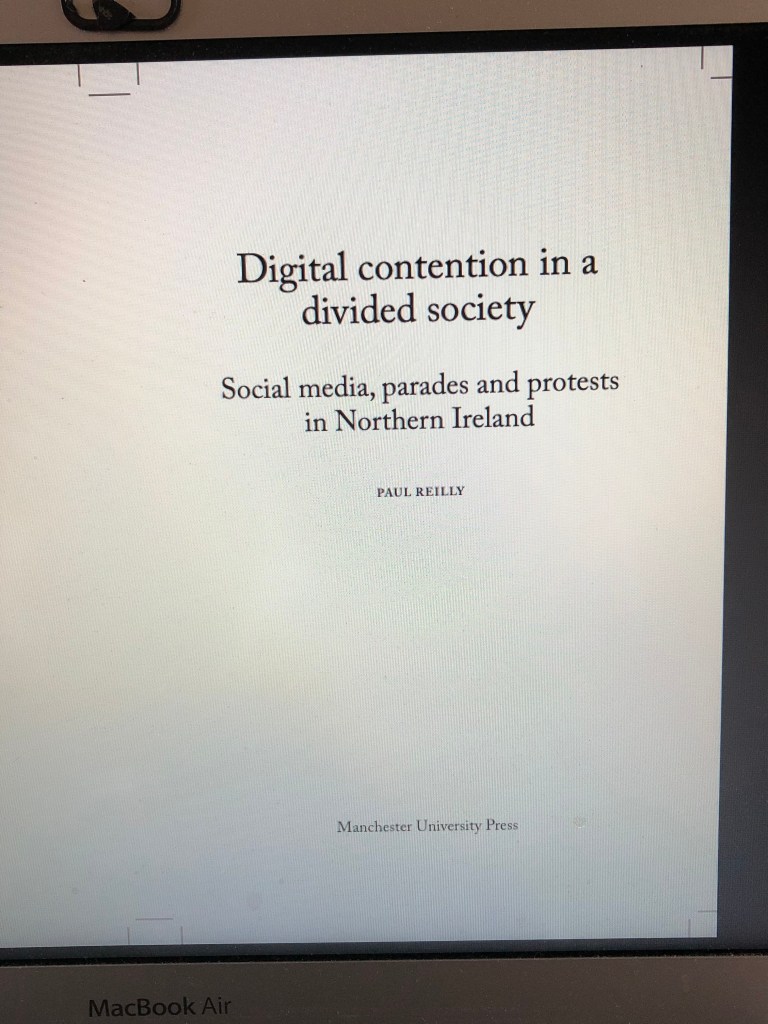
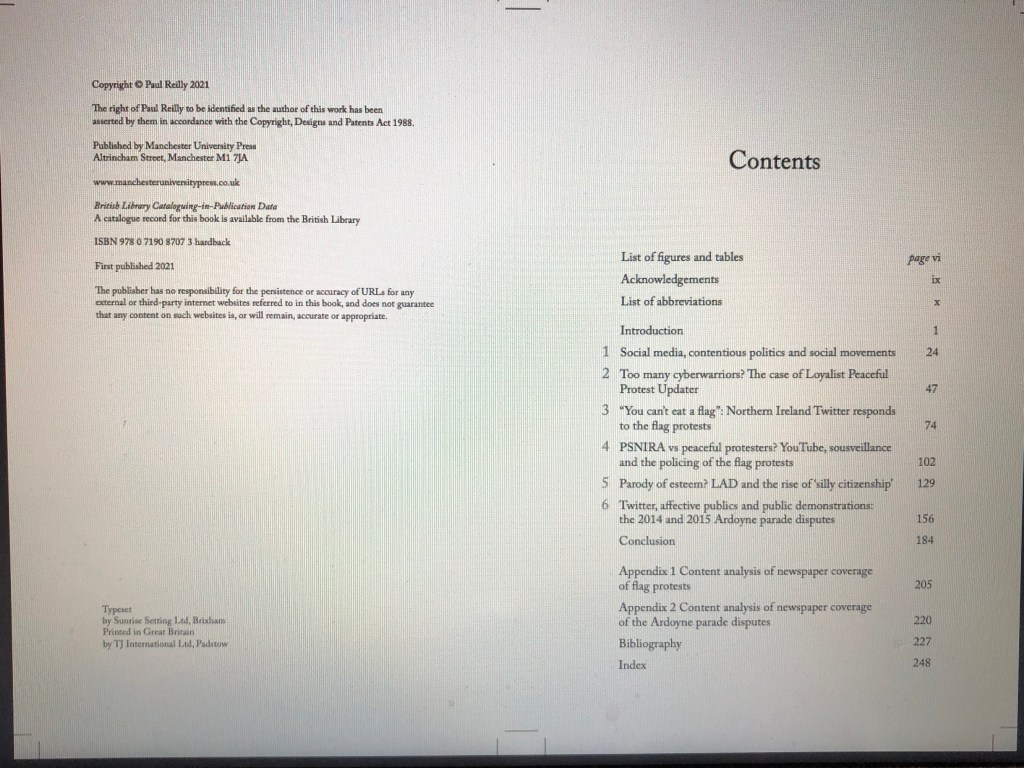
I have received the proofs for my new book Digital Contention in a Divided Society: Social media, parades and protests in Northern Ireland, due to be published by Manchester University Press on 1 February 2020.

Here is a brief description of the book:

How are platforms such as Facebook and Twitter used by citizens to frame contentious parades and protests in ‘post-conflict’ Northern Ireland? What do these contentious episodes tell us about the potential of information and communication technologies to promote positive intergroup contact in the deeply divided society? 

These issues are addressed in what is the first in-depth qualitative exploration of how social media were used during the union flag protests (December 2012-March 2013) and the Ardoyne parade disputes (July 2014 and 2015). The book focuses on the extent to which affective publics, mobilised and connected via expressions of solidarity on social media, appear to escalate or de-escalate sectarian tensions caused by these hybrid media events. It also explores whether citizen activity on these online platforms has the potential to contribute to peacebuilding in Northern Ireland.

The book will be available in both print and eBook format and can be pre-ordered here

Book on Social Media Research Ethics contracted with SAGE

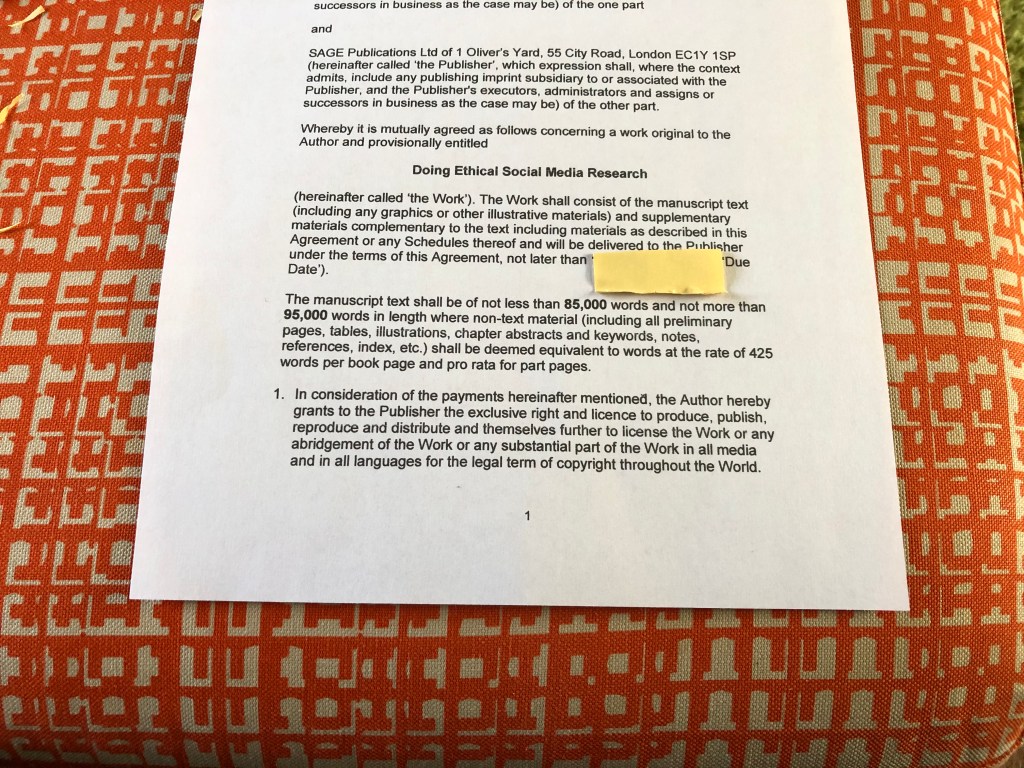
Doing Ethical Social Media Research, contracted with SAGE, due 2022.

Yesterday I received the contract for my next book. ‘Doing Ethical Social Media Research’ will be published by SAGE in 2022. This book will explore the foundations of ethical decision-making, the perspectives of researchers on how to conduct ethical social media research, and how to address these issues when researching high-risk contexts and contentious issues.

The book will be a hybrid research methods text aimed at students, researchers and anybody with an interest in social media research. It will include summaries of key issues and exercises for those wanting to learn more about digital research ethics.

Many thanks to Michael Ainsley at SAGE for all his help in getting this contract over the line, and for the thoughtful and generous feedback of all the reviewers.

I look forward to working on this project with Michael and the team in 2021. I will try to post updates on here throughout the next 18 months.

New article published on social media and sousveillance

I have a new article in the journal First Monday out today. Entitled ‘PSNIRA vs. peaceful protesters? YouTube, ‘sousveillance’ and the policing of the union flag protests,’ it explores how Youtubers responded to footage of alleged police brutality during the union flag protests in Northern Ireland between December 2012 and March 2013. 

Drawing on a qualitative analysis of 1,586 comments posted under 36 ‘sousveillance’ videos, I argue that responses to these videos were shaped by competing narratives on the legitimacy of police actions during the flag protests. This footage focussed attention on the anti-social behaviour of the protesters rather than the alleged police brutality referred to in the video descriptions. The paper concludes by considering the problematic nature of exploring imagined sousveillance, as was the case here, through the collection and analysis of ‘easy data’ scraped from online platforms such as YouTube. The paper can be accessed here

New article published in Journalism

  • Delighted to have an article co-authored with Bournemouth University colleagues Anastasia Veneti and Darren Lilleker published in Journalism yesterday.
  • The article entitled ‘Photographing the Battlefield’: the role of ideology in photojournalist practices during the anti-austerity protests in Greece’ can be accessed here