This week I was at Edinburgh Napier University to attend the annual MeCCSA conference. The theme this year was ‘Identity and Belonging’, with a specific focus on how identities are mediated and mediate themselves.
First, I was part of a Glasgow University Media Group panel on the Cost of Living Crisis. I presented an overview of the key findings with Cairsti Russell and Gavin Hawkton (unfortunately Catherine Happer was unable to join us due to ill-health).
Key themes included the debate over the use of the word ‘crisis’. There was also a focus on the impact of austerity and cuts in public services on low-income households. Our results suggest that media coverage of the COLC prioritised business perspectives over those of civil society. Citizens are increasingly attracted to alternative news sources. The slides from the session can be viewed below:
These findings are from the GUMG’s forthcoming book ‘Bad News for the Cost of Living Crisis’. The book, edited by Catherine Happer, Alison Eldridge and me, will be published with Palgrave Pivot in December 2025.
My second paper was on my ongoing research on social media, parades and protests in Northern Ireland. I drew on my book Digital Contention in a Divided Society and article on #Brexitriots in my presentation. It explored hashtags as affective ritualised responses to contentious events in Northern Ireland. I examined who was behind these discursive formations online, and who benefited from this activity. The slides can be viewed below:
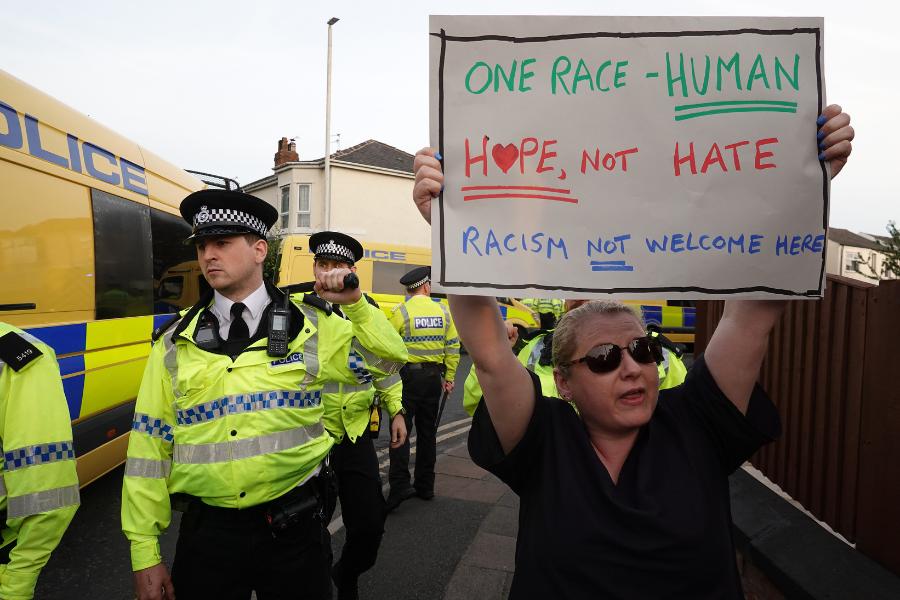
In this piece, I analyse the role of social media misinformation in the Southport riots earlier this week. I explore how online platforms circulated false information alleging the attacker was Muslim, a migrant and a refugee.
I argue that while social media helped amplify tensions, their role should not be overblown. Politicians must also take some responsibility for their role in creating a toxic discourse surrounding immigration.
Many thanks to Avery Anapol for the invitation to write this piece.
Scotland’s distinctive public sphere: a media policy roundtable
This roundtable will explore Scotland’s distinctive media and public sphere, with a particular focus on questions of sustainability in respect of funding, trust and the changing regulatory landscape. It contextualises these questions in a turbulent political environment, in which the constitutional question continues to dominate, and the radical changes brought by digital technologies.
Devolution in 1999 significantly shifted Scotland’s political landscape, and 2014’s referendum illuminated the way in which Scotland’s public sphere has developed in parallel as an often uncomfortable hybrid of UK-rooted institutions and emerging Scottish players. Analysis of media structures in the devolved state have however often been subsumed under UK-wide research which can fail to fully illuminate Scotland’s distinct challenges and nature.
This roundtable draws on a recent stakeholder report produced by academics at Glasgow University. Speakers will share insights on a set of key themes including sustainable funding and support for Scotland’s media and how it works in other small countries, digital regulation and competition, holding power to account in Scotland, and the impacts of global digital media on engagement with local issues. It will then invite contributions from the panel speakers and audiences about the future trajectory of Scotland’s media in the next decade.
Participants will include:
Dr Paul Reilly, Senior Lecturer, Politics Dr Catherine Happer, Director of Glasgow University Media Group (GUMG), Sociology Professor Philip Schlesinger, Professor in Cultural Theory, and Dr Dominic Hinde, Lecturer, Sociology.
Tomorrow (5 September), I will be presenting a paper based on a project that explored social media, sectarianism and football in Scotland. The panel, entitled Scottish Media and Culture, place at 9am in Room W010B (Annie Lennox Building). The abstract can be read below.
#ScotlandsShame: Twitter, affective publics and football-related sectarianism in Scotland
Social media have frequently been identified as a significant contributing factor to sectarianism in contemporary Scotland. What is typically absent from these debates is empirical evidence showing the prevalence of sectarianism on online platforms in relation to football, and specifically how the rivalry between Celtic and Rangers fans is contested online. This paper sets out to address this gap through a qualitative study of tweets (N=84,028) posted during the disorder that followed the Rangers ‘title celebrations’ in Glasgow city centre on 15 May 2021. Results indicate that there was much evidence of dehumanising and sectarian language being used to ‘other’ Rangers supporters. Hashtags like #ScotlandsShame were used by citizens to document their experiences of what they perceived as the ‘anti-Catholic bigotry’ on display in the city centre that evening. The Scottish establishment was criticised for not doing enough to eliminate this bigotry, whether it be in the form of banning contentious Orange Order marches or abolishing segregation within schools. In response, Rangers supporters accused the Scottish Government of having an agenda against their club, as demonstrated by its failure to condemn the anti-deportation protests at Kenmure Street a few days earlier. In this way, social media afforded these affective publics opportunities to contest the dominant media narratives on both the Celtic-Rangers rivalry and football-related sectarianism in Scotland. The paper concludes by considering whether the sectarianism visible on online platforms during such contentious events is reflective of broader societal trends.
Many thanks to Emily and the PSA MPG organisers for the opportunity to participate in the series. Details on how to register for the event can be found here
The Conversation UK have published an essay of mine on how to follow Northern Irish protests on social media. Drawing on my research on the union flag protests, Ardoyne parade dispute and my recently published book, I argue that we should all be careful about what we share on sites like Facebook and Twitter during the marching season. Key tips such as ‘Check before you share’, ‘know who to follow’ and ‘play the ball, not the person’ are shared in the piece. I also recommend following journalists and factchecking organisations such as FactCheckNI in order to counter the spread of misinformation and disinformation.
Many thanks to Victoria Wood for helping with the pitch and Avery Anapol for providing feedback on the final version. The post can be viewed here
My new article Countering misinformation and disinformation during contentious episodes in a divided society: Tweeting the 2014 and 2015 Ardoyne parade dispute has recently been published in First Monday. Drawing on research that features in my recently published book Digital Contention in a Divided Society, the article presents the results of a qualitative thematic analysis of 7388 tweets containing ‘Ardoyne’. The study found that misinformation and disinformation constituted a very small proportion of the Twitter activity surrounding the 2014 and 2015 parades. Citizens directly challenged those responsible for sharing visual disinformation during this acute event, while journalists fact-checked unsubstantiated claims and refrained from amplifying misinformation in their coverage. However, the potential impact of social media activity upon events on the ground should not be overstated. There were no incidents of sectarian violence in these years directly attributed to false information shared online. Online misinformation and disinformation are likely to remain a feature of these parades for as long as they remain contentious. The Ardoyne impasse was symptomatic of the failure of political elites from the two main sectarian blocs to address issues such as controversial parades and protests. Thanks to Edward J. Valauskas, First Monday and the reviewers for their comments. The article can be read here
The NTU Research Centre for the Study of Inequality, Culture and Difference is delighted to welcome Dr Paul Reilly from the University of Sheffield 2-3pm BST on Wednesday 28th April, who will be giving a talk on Social media, parades and protest in a Divided Society: Reflections from post-conflict Northern Ireland.
Abstract:
How are platforms such as Facebook and Twitter used by citizens to frame contentious parades and protests in ‘post-conflict’ Northern Ireland? What do these contentious episodes tell us about the potential of information and communication technologies to promote positive intergroup contact in the deeply divided society? In this paper, I will explore these issues through the first in-depth qualitative exploration of how social media were used during the union flag protests (December 2012-March 2013) and the Ardoyne parade disputes (July 2014 and 2015). I examine the extent to which affective publics, mobilised and connected via expressions of solidarity on social media, appear to escalate or de-escalate sectarian tensions caused by these hybrid media events. I conclude by examining whether citizen activity on these online platforms has the potential to contribute to peacebuilding in divided societies such as Northern Ireland. Bio: Dr. Paul Reilly is Senior Lecturer in Social Media & Digital Society at the University of Sheffield. His research focuses on social media sousveillance, digital activism and the use of digital media to promote better community relations in divided societies. He has written two books on the role of digital media in conflict transformation in Northern Ireland (Framing the Troubles Online and Digital Contention in a Divided Society, both with Manchester University Press). His work has also been published in a number of journals including First Monday, Information, Communication & Society, Journalism, New Media & Society, and Policy & Internet.
There is no registration for the seminar, and you can access it using the link below:
I have an essay in Human:Putting the Social into Science on the role of social media in the recent riots in Northern Ireland. It begins by exploring the factors that have underpinned the protests and related violence seen in Northern Ireland over the past two weeks, including the border created down the Irish Sea by the Northern Ireland Protocol and loyalist accusations about ‘two-tier policing’ in the wake of the PPS decision not to not to recommend any prosecutions for republicans who broke COVID rules during the funeral of senior PIRA member Bobby Storey in June 2020. Like the flag protests eight years ago, these street protests have also articulated increasing loyalist dissatisfaction with the Stormont Assembly and the peace process in general.
Drawing on my recently published book Digital Contention in a Divided Society, I argue that there are comparisons to be made in terms of how online platforms were used during the flag protests. Messages calling for loyalists to “shut down Northern Ireland” have reverberated around Facebook, Twitter, and WhatsApp. Videos recorded on smartphones showing the effects of the violence in interface areas have again become a focal point for the anger of online commentators. Mis-and disinformation is once again spreading via these platforms, as demonstrated by messages emanating from false flag accounts urging loyalist youths to “earn their strips” [sic] by engaging in violence. While social media may not be ‘fuelling’ these protests, the speed with which such information circulates presents a formidable challenge to those seeking to keep these demonstrations peaceful. Ultimately, political leadership is required if Northern Ireland is to avoid a contentious marching season this summer.
Thanks to Laura Lightfinch and Victoria Wood for their help with this. The piece can be read here
Book review published in View Digital, 12 April 2021
The first review of Digital Contention in a Divided Society has been published in VIEWdigital this week. Some excerpts are below:
“Dr Reilly’s book highlights the need for ongoing discussions on the role of digital media in societies such as Northern Ireland, which face deep divisions. It is a place where contentious policies developed at polished tables of ministers and civil servants can result in a young person throwing a petrol bomb at a so called ‘peace wall’.
“It is an important addition to research on digital disinformation and misinformation in a society were conflict and division remain worryingly close to the surface”.
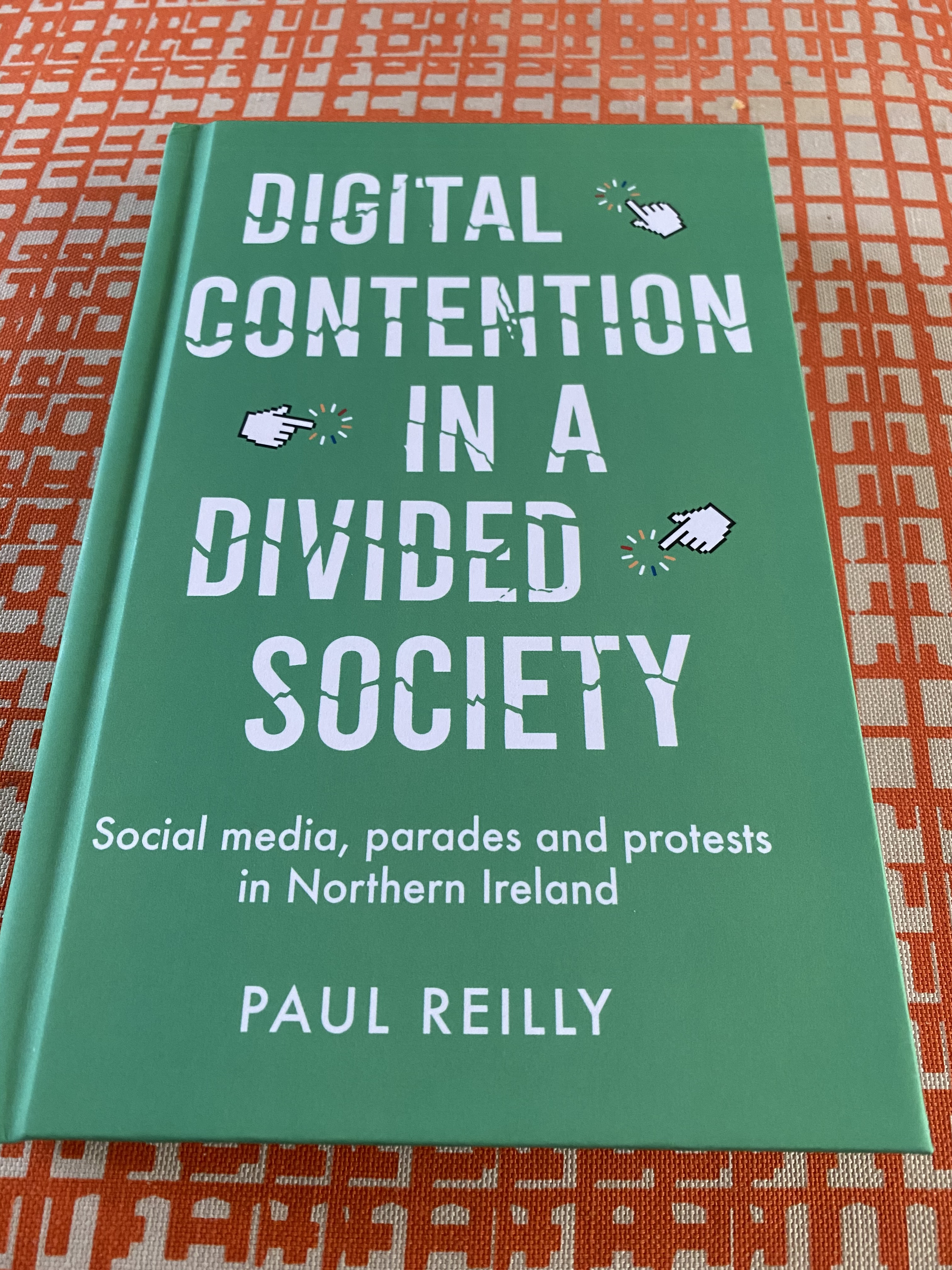
Digital Contention in a Divided Society, out now
I am very grateful to Una Murphy for this very generous review and to both her and Brian Pelan for publishing this piece.
Digital Contention in a Divided Society was published last month. The official (online) book launch hosted by Manchester University Press was on 29 January, where I was in conversation with John Coster (Doc Media Centre). Thanks to Chris Hart (MUP) for all the support and for making this video available:
Book launch hosted by Manchester University Press, 29 January 2021
Digital Contention can be purchased in hardback and eBook here
Reviews:
‘Much that is written about the politics of Northern Ireland is based on highly selective accounts of the available evidence. Reilly eschews this approach, subjecting the political use of social media to sustained critique in this empirically rich study. In so doing, he makes a very valuable contribution to scholarship.’ Phil Ramsey, Lecturer in the School of Communication and Media, Ulster University
‘A timely historical account cataloguing a rich collection of the author’s empirical research, the book evinces continuity in polarisation among Northern Irish communities online. Showing how the use of social media adds further complexity to community relations, for instance through the pointed concept of ‘silly citizenship’, Reilly meticulously dispels earlier techno-optimism while further contextualising the algorithmic power of social media.’ Dan Mercea, Reader in Media and Communication, City, University of London
‘While the darkest days of Northern Ireland’s ‘troubles’ are over, the divisions have left lasting scars and in the twenty-first century the competing interpretations of the conflict and the country’s constitutional status remain entrenched. Reilly’s work explores the contribution of digital citizenship to peacebuilding within this complex context. The comprehensive and engaging analysis explores how a society beset with deeply held prejudices form online communities, share content and can be misled by misinformation so contributing to a range of wider debates on the role of digital media. As with many studies Reilly identifies positives, such as Citizen Assemblies and accounts that scrutinize decision making, as well as the acts of ‘silly citizenship’ which satires sectarianism and can exacerbate divide. Reilly’s work is an important contribution to our understanding of digital politics, how platforms can be a force for good or ill depending on the motivations and behaviour of users, and how forms of digital citizenship can support or disrupt societal healing processes. Reilly’s study is a must read for scholars and students seeking to understand the complex roles which digital technologies play in socio-political life as well as for those seeking to understand the dynamics of present day Northern Ireland and how it might face the challenges of a post-Brexit world.’ Darren Lilleker, Professor of Political Communication, Bournemouth University
I have been given a discount code which I can share, so please email me (p.j.reilly@sheffield.ac.uk) if you want to purchase a copy.





 Dr Paul Reilly