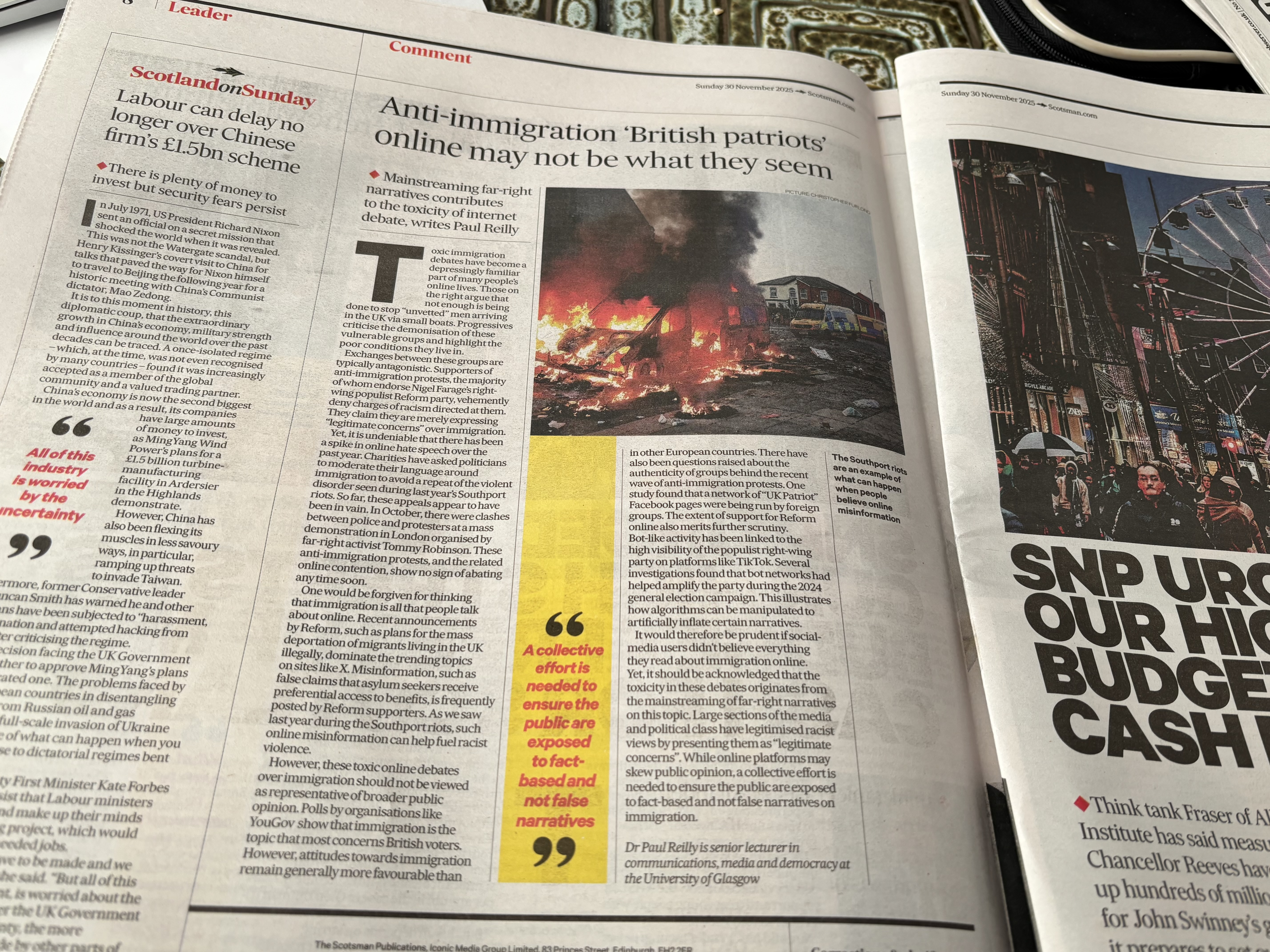
Yesterday I had an op-ed published in Scotland on Sunday. I discussed the toxic immigration debates on social media and the rise of Nigel Farage’s Reform party online. My argument was that we should be more sceptical of what we see online. There is already evidence that bots are used to amplify Reform’s talking points on this issue. The public is apparently obsessed with ‘small boats’ and ‘illegal immigration’. This is due to years of mainstreaming far-right narratives on this topic. I conclude with the argument that a collective effort is required. This effort must ensure that social media users are exposed to facts. It is essential they are not misled by false narratives on immigration.
I have had an op-ed published on LBC Views yesterday. I discussed how social media platforms will face penalties for not doing more to combat online misinformation and hate speech that contributed to the UK riots. I also argued that politicians and public figures who have created a toxic discourse around immigration need to take some of the blame for the civil unrest too.
Thanks to Katy Rankin for the invitation. The post can be read here
On Saturday I appeared on BBC Scotland’s Good Morning Scotland programme to discuss freedom of expression online. Suzanne Whitten (Queen’s University Belfast) and I discussed a variety of topics including Twitter/X owner Elon Musk’s claims to be a ‘free speech absolutist’, what type of platform regulation might emerge after the UK riots, and the contested definition of ‘free speech’.
Many thanks to Brian and the GMS team for the invitation. The segment can be listened to here.
Yesterday I had an op-ed published in The Scotsman. In ‘Social media tycoon won’t act to ditch harmful content, I review the various ways online platforms could be better regulated in order to avoid a repeat of the misinformation linked to the recent violence in the UK. These include calls for temporary shutdowns, stronger financial penalties, and even the suspension of operating licences. I also discuss the ways citizens can counteract hate speech and msinformation that contributes to civil unrest.
Many thanks to Charlotte Morris for helping arrange this. It can be read in full here.
Delighted to have written an article for VIEWdigital on the responsibility of social media for amplifying hateful content during the UK riots. I argue that there are some steps that users can take to mitigate its impact if platforms are unwilling to take stronger action on hate speech and misinformation.
Many thanks to Brian Pelan and Una Murphy for the invitation. The article can be read here
Last week I visited the last divided city in the world for the first time. The inevitable online search for tourist attractions in the Cypriot capital highlighted the United Nations Buffer Zone (or ‘Green Line’) as a must-see. It was also recommended that tourists bring their passports and cross over into the Turkish side of the city. Having previously visited Belfast’s ‘peace walls’ and the few remaining sections of the Berlin Wall, I was keen to see how the urban landscape of Nicosia had been shaped by conflict. So, my friend and I gathered our passports and set off from our hotel to explore the Greek and Turkish sides of the city.
Watchtower in UN Buffer Zone
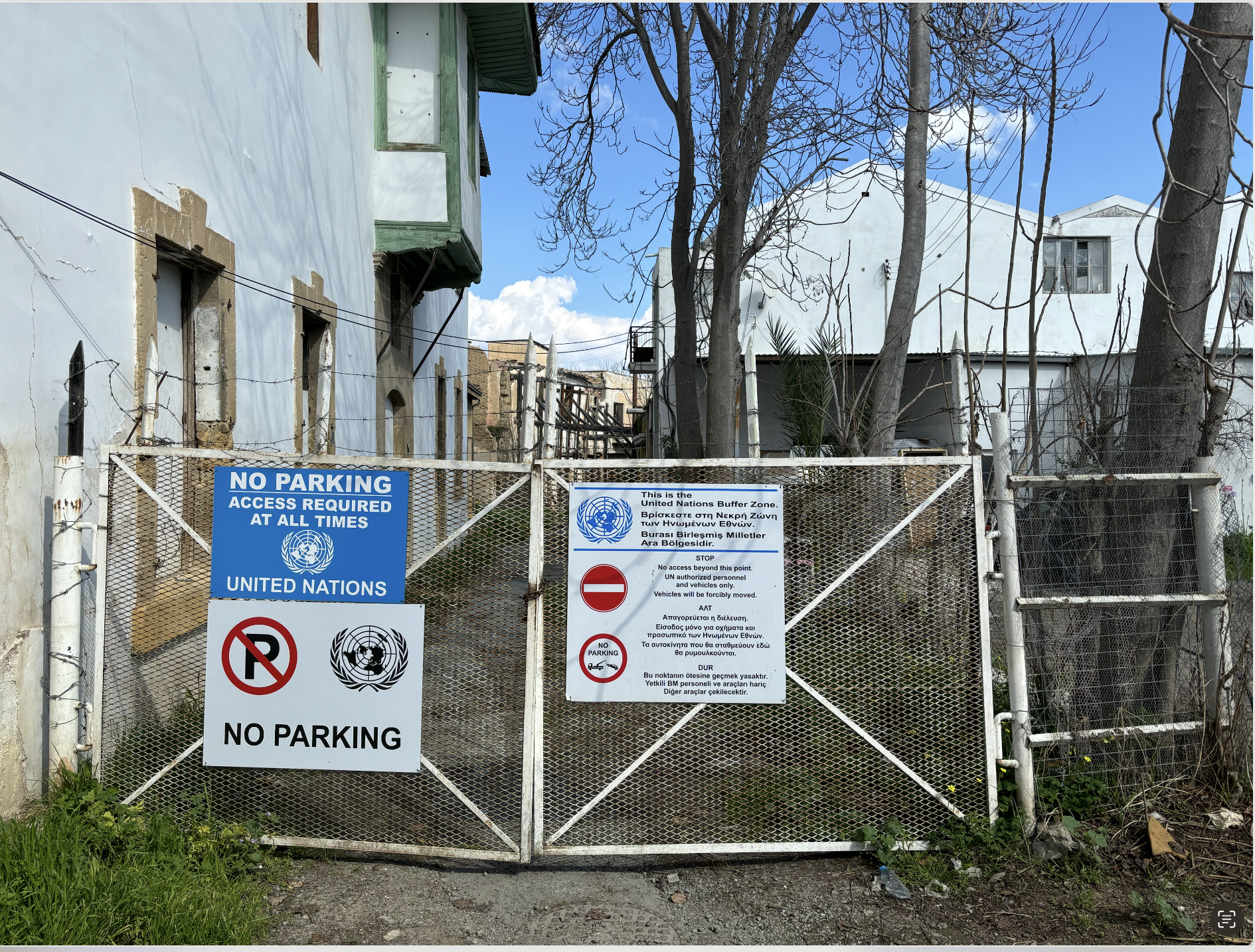
Our first stop was the Green Line Hut, an abandoned security checkpoint situated close to the buffer zone. A Greek flag painted on a nearby wall and a series of ‘Stop’ signs were visible reminders of its previous function. These were overshadowed by an even larger warning sign telling tourists that photographs were prohibited. A few yards away was our first glimpse of the buffer zone. Boarded up buildings were visible behind barbed wire fences. A sign on a security access gate confirmed entry was forbidden and warned that no parking was permitted in front of it.
Abandoned street in UN Buffer Zone
What was particularly striking was how everyday life continued as normal in the immediate vicinity. A large green bin was stationed in front of the Hut. We also witnessed a resident bringing shopping into their house, which was on the ‘Green Line’ and only a few metres away from the abandoned buildings in the buffer zone.
Green Line Hut
Our next stop was the Ledra Palace Border Crossing Point. A sign next to the checkpoint on the Greek side showed pictures of two men who had lost their lives protesting against the Turkish occupation
Poster at Ledra Palace Crossing Point
A quick inspection of our passports and we were finally in the UN controlled area. Signs of the UN presence were everywhere, from car park spaces reserved for its personnel to signs outside the Ledra Palace Hotel (now a UN base) outlining its various peace initiatives on the island.
Ledra Palace hotel, UN Buffer Zone
Yet just across the road an abandoned house, with sandbags instead of windows and weeds growing over its roof, was a visual reminder of the violence 50 years earlier.
Abandoned house in UN Buffer Zone
A few hundred yards down the road we arrived at the next checkpoint, marked by several Turkish flags and a banner declaring ‘Turkish Republic of Northern Cyprus FOREVER’.
Border checkpoint, North Nicosia
We had been told that the north felt very different than the south. This was certainly our experience. There were few modern high-rise office blocks and the high-street stores near our hotel were nowhere to be seen. Instead, a mix of gold, jewellery and fake designer gear were on display in the predominantly empty shops we passed. In contrast to the Costa and Starbucks in the south, men sat outside Turkish coffee houses and restaurants playing dominos and other board games. What appeared to be a vintage Pepsi billboard outside a café was emblematic of a city that had barely changed in decades.
Shopping district in North Nicosia
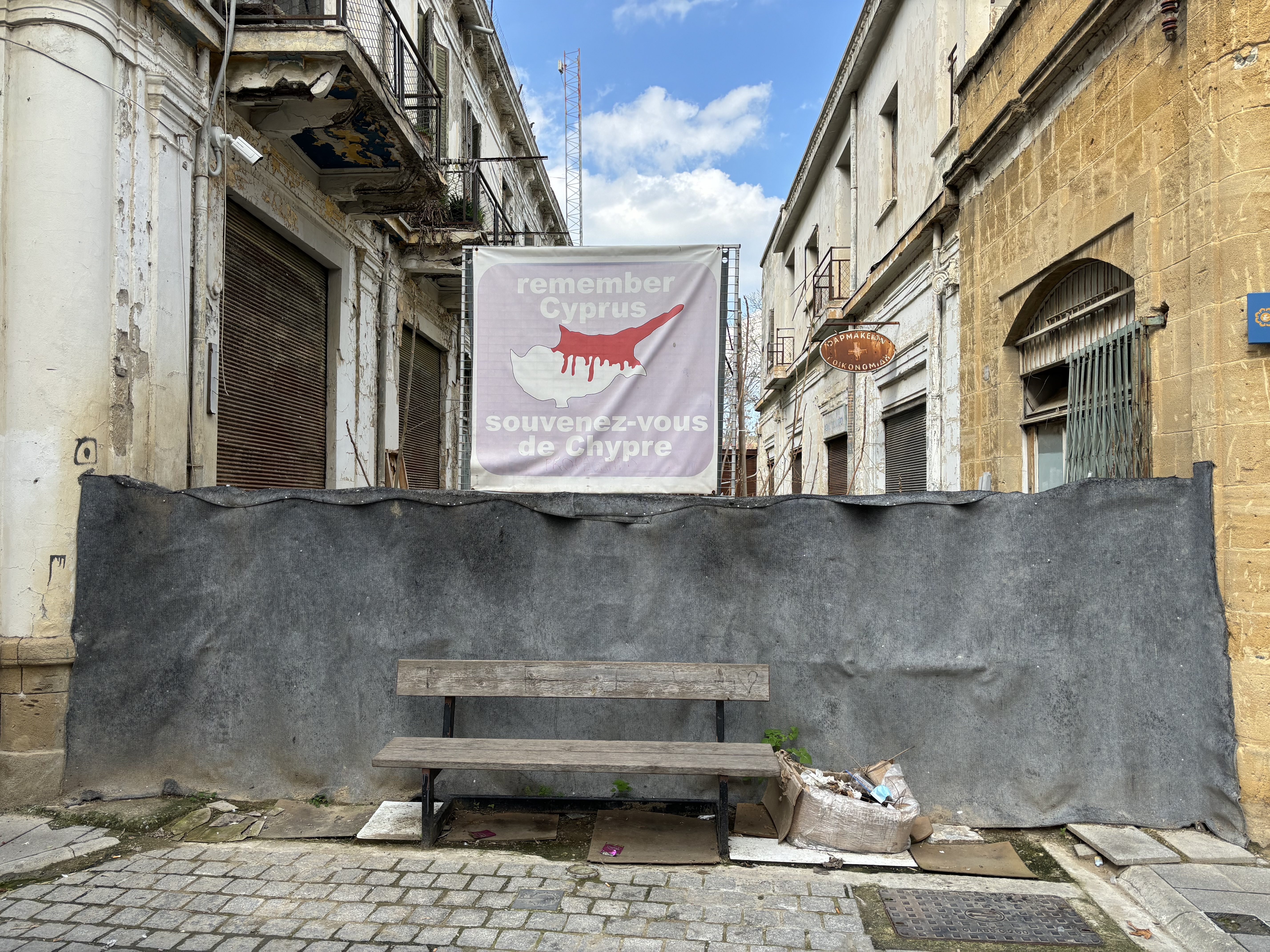
Returning across the border, we walked along the Green Line from the southern side. At the aptly named Berlin Café I was warned by a soldier not to take photographs of a military lookout post. We were able to peer over into the buffer zone by standing on a bench, against the backdrop of a banner calling on tourists to ‘Remember Cyprus’.
UN Buffer Zone viewed from south side of Green Line
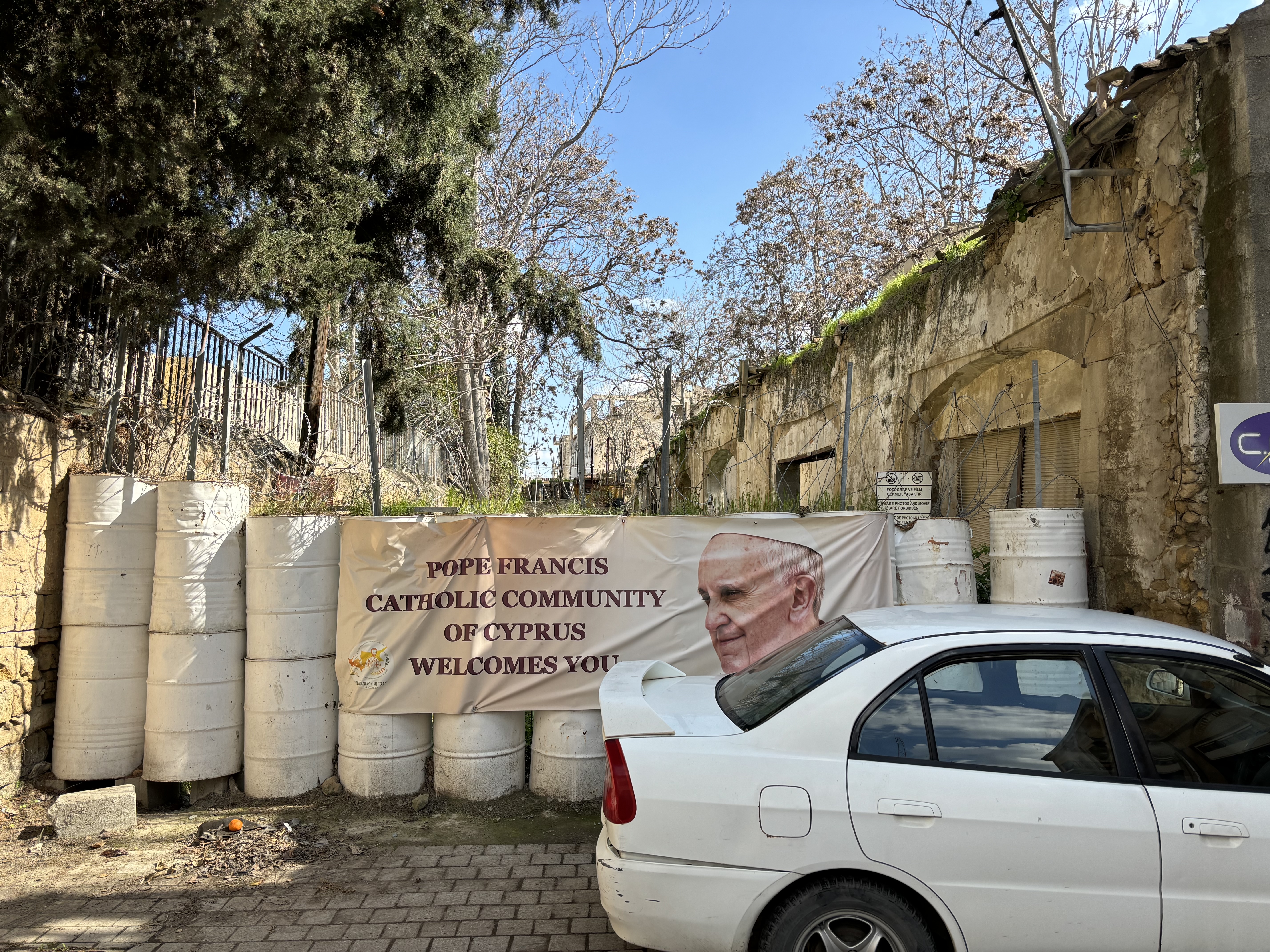
Once again, there was a sense that local residents were going about their daily lives against the eerie backdrop of the Green Line. A white car was parked next to a barricade of white oil drums and barbed wire close to the Church of the Holy Cross. A banner welcomed Pope Francis on behalf of the Catholic community of Cyprus.
Barricade near Church of Holy Cross
I would strongly recommend walking the Green Line in Nicosia if you haven’t done so before. It serves as a reminder of the devastating impact that war has on people’s lives, possessions and property. Hopefully a solution to the ‘Cyprus problem’ can be found, one which sees a complete demilitarisation of the buffer zone and a new life returning to this decaying urban landscape.
In a wide-ranging conversation, we reflected on the role of media in how we remember conflict, some of the key themes in papers presented at our recent workshop in Glasgow, and the horrific events unfolding in Gaza.
Many thanks to John for the invitation and the engaging chat (as always!). The interview can be viewed below:
Scotland’s distinctive public sphere: a media policy roundtable
This roundtable will explore Scotland’s distinctive media and public sphere, with a particular focus on questions of sustainability in respect of funding, trust and the changing regulatory landscape. It contextualises these questions in a turbulent political environment, in which the constitutional question continues to dominate, and the radical changes brought by digital technologies.
Devolution in 1999 significantly shifted Scotland’s political landscape, and 2014’s referendum illuminated the way in which Scotland’s public sphere has developed in parallel as an often uncomfortable hybrid of UK-rooted institutions and emerging Scottish players. Analysis of media structures in the devolved state have however often been subsumed under UK-wide research which can fail to fully illuminate Scotland’s distinct challenges and nature.
This roundtable draws on a recent stakeholder report produced by academics at Glasgow University. Speakers will share insights on a set of key themes including sustainable funding and support for Scotland’s media and how it works in other small countries, digital regulation and competition, holding power to account in Scotland, and the impacts of global digital media on engagement with local issues. It will then invite contributions from the panel speakers and audiences about the future trajectory of Scotland’s media in the next decade.
Participants will include:
Dr Paul Reilly, Senior Lecturer, Politics Dr Catherine Happer, Director of Glasgow University Media Group (GUMG), Sociology Professor Philip Schlesinger, Professor in Cultural Theory, and Dr Dominic Hinde, Lecturer, Sociology.
Tomorrow (5 September), I will be presenting a paper based on a project that explored social media, sectarianism and football in Scotland. The panel, entitled Scottish Media and Culture, place at 9am in Room W010B (Annie Lennox Building). The abstract can be read below.
#ScotlandsShame: Twitter, affective publics and football-related sectarianism in Scotland
Social media have frequently been identified as a significant contributing factor to sectarianism in contemporary Scotland. What is typically absent from these debates is empirical evidence showing the prevalence of sectarianism on online platforms in relation to football, and specifically how the rivalry between Celtic and Rangers fans is contested online. This paper sets out to address this gap through a qualitative study of tweets (N=84,028) posted during the disorder that followed the Rangers ‘title celebrations’ in Glasgow city centre on 15 May 2021. Results indicate that there was much evidence of dehumanising and sectarian language being used to ‘other’ Rangers supporters. Hashtags like #ScotlandsShame were used by citizens to document their experiences of what they perceived as the ‘anti-Catholic bigotry’ on display in the city centre that evening. The Scottish establishment was criticised for not doing enough to eliminate this bigotry, whether it be in the form of banning contentious Orange Order marches or abolishing segregation within schools. In response, Rangers supporters accused the Scottish Government of having an agenda against their club, as demonstrated by its failure to condemn the anti-deportation protests at Kenmure Street a few days earlier. In this way, social media afforded these affective publics opportunities to contest the dominant media narratives on both the Celtic-Rangers rivalry and football-related sectarianism in Scotland. The paper concludes by considering whether the sectarianism visible on online platforms during such contentious events is reflective of broader societal trends.
Bored Panda interview about how people share content on social media
I was interviewed by Ieva Gailiūtė for Lithuanian publication Bored Panda this week. We discussed why people share things on social media without checking their accuracy, and the negative impacts of people being shamed for historic posts.
Some quotes from the interview are below:
When asked why social media users often share their thoughts without thinking twice, Dr. Reilly explained the design of online platforms encourages instant responses and reactions. “The stories, images and posts that feature prominently in our social media timelines are often the most likely to elicit emotional responses from us.”
“The ‘publish then filter’ model of these sites also means our opinions are published immediately with no cooling off period for us to consider whether we want to post them or not,” he added.
When asked whether our online contributions always become permanent, Dr. Reilly told us, “Yes and No. It’s true that social media posts are no longer your property when you share them publicly, or even privately given that they can be shared by others. Even on encrypted apps like WhatsApp and Snapchat, people can take screenshots of content deleted by others and share them later.”
“However, there needs to be a motivation for someone to do this,” he continued. “This is why we see so many politicians being shamed for historic (and often deleted) social media posts. The consequences can be severe, ranging from embarrassment, reputational harm, people losing jobs and even worse.” Especially because sometimes, digital content can be made permanent in ways we never imagined. The posts can be changed, modified, or altered into something completely different from what they originally intended to be.
“People should ideally verify the information before they share it, but many don’t,” he said. “However, it should also be noted that people are better at detecting ‘fake news’ and disinformation than they are often given credit for.”
So even when we can essentially say whatever we want online — whether it’s objectively true or not — and not really have very serious consequences for it, we should all strive to make social media a better place. “Read the story before you share it. Satisfy yourself that it is based on an authoritative source. If it makes you feel an extreme emotion then be wary — this is often a sign that it is disinformation designed to polarize audiences,” Dr. Reilly concluded.
Many thanks to Ieva for the invitation. The article can be read here







 Dr Paul Reilly
