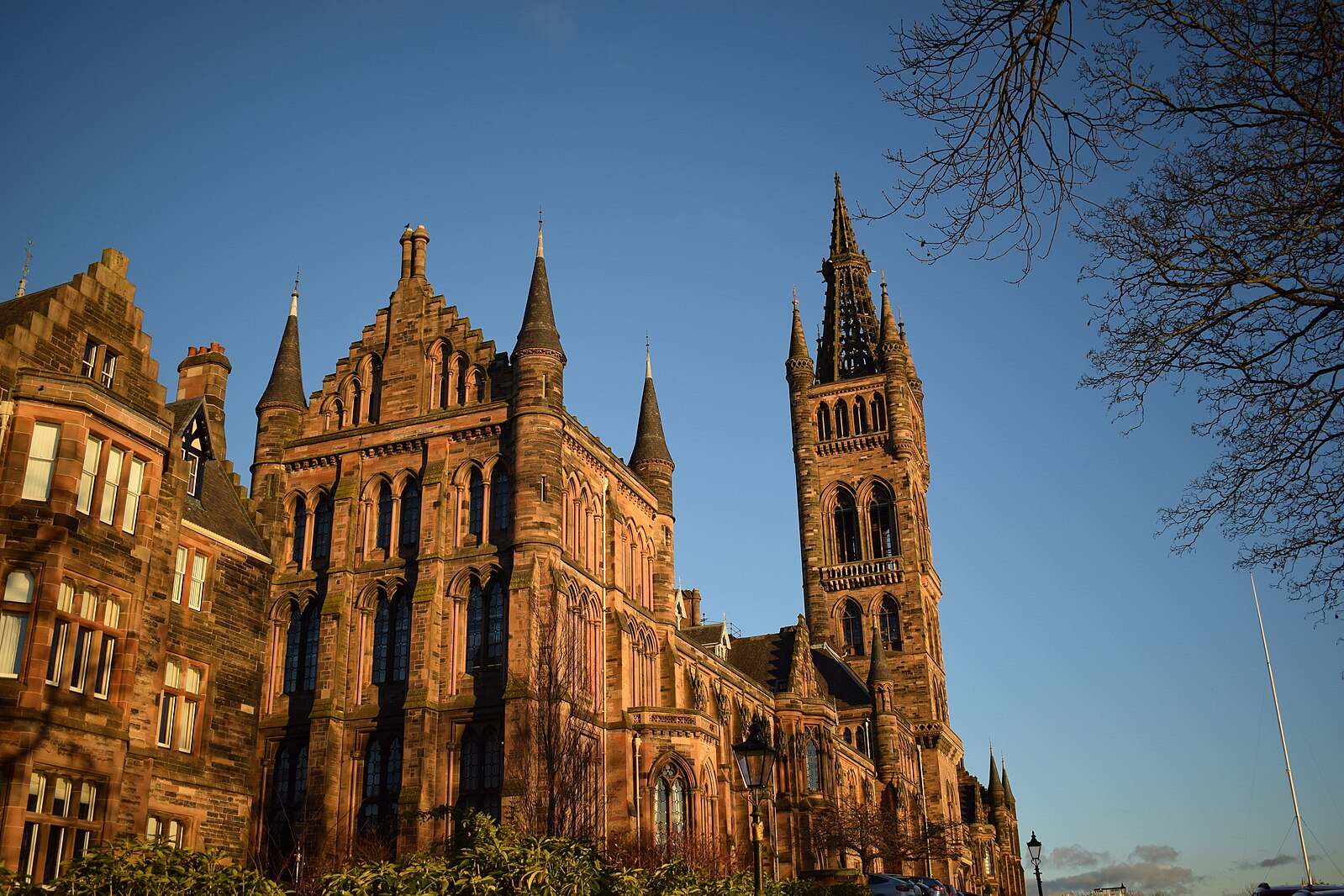
Photo by Clem_nat reproduced by Creative Commons Attribution-Share Alike 4.0 International
Yesterday I was delighted to hear that the Media Research Methods team had received the Teaching Team Award. This was part of the annual School of Social Sciences Learning & Teaching Awards. It recognises excellence in teaching at the University of Glasgow. I was one of 19 colleagues to get this the award (the full names are listed below).
The award committee noted:
“Team teaching is not new our school, but we have recently seen bigger and bigger teams coming together to develop core courses for our largest programmes. The challenge for team delivered courses is the ability to ensure coherence of experience for all students. This is something that the event winners of this award certainly achieved over the past year. Responsible for the largest single course in the school, the judging committee noted that the Media Research Methods team delivered an outstanding first run of a complex, large-scale course, driven by effective collaboration, care, and a shared commitment to over 460 students success”.
I would like to congratulate the rest of the team for all their hard work last year. I want to especially acknowledge Harvey and Lluis for their work convening this course. The full list of recipients is below- congratulations to all!:
Lluis de Nadal Alsina, Harvey Humphrey, Kirstie Ken English, Catriona Forrest, Catherine Happer, Isaac Hoff, Hayes Mabweazara, Ida Norberg, Galina Oustinova-Stjepanovic, Paul Reilly, Cairsti Russell, Lito Tsitsou, Erdem Avsar, Emma Flynn, Adnan Hossain, Caroline Leicht, Ashli Mullen, Yu Sun, Kenneth Ward
Research Culture & Researcher Development, University of Glasgow
I have been recognised as an Outstanding Mentor by the University of Glasgow’s Research Culture and Researcher Development (RCRD) team. One of my mentees (very kindly!) wrote this about my mentoring skills:
“The mentorship has helped me to take think about the priorities in my career and has facilitated taking important career decisions. My mentor has given me insights on different dimensions to consider when planning to move to the next career stage and has helped me to reflect over those dimensions in very productive way..”
Thanks to all of my mentees and Dr. Elaine Gourlay of the RCRD team for their very positive feedback and support- very much appreciated!
Suay Melisa Özkula and I were honoured to receive an award at the annual International Communication Association (ICA) conference in Australia today. Our paper ‘Where is the Global South? A Systematic Review of Regional Visibilities in Digital Activism Research’ received the Top Faculty Paper from the ICA’s Activism, Communication and Social Justice Interest Group.
Best Faculty Paper Award, ICA ACSJ 2024
Many thanks to the reviewers and the ACSJ team (Rasha, Hanan and Betty) for the award.
If you are at #ICA24 you can see Suay present our paper as part of the Digital Activism and Social Justice panel on Monday (3:00 PM – 4:15 PM; Surfer’s Paradise 1 Star L3).
Suay picking up our award at the ACSJ Business Meeting!
The abstract for the paper can be read below:
Where is the Global South? A Systematic Review of Regional Visibilities in Digital Activism Research
Recent scholarship has problematised the dominance of the Global North within communication research and called for de-westernisation to incorporate more cosmopolitan perspectives (Badr & Ganter, 2021; Bosch, 2022; Waisbord, 2022). While some scholars argue that a ‘decolonial turn’ in digital media research is occurring (Couldry &Mejia, 2021), it remains unclear whether this is also the case in digital activism (abbreviated: DA) research. Extant scholarship suggests that ‘Western’ social media platforms and activism from Global North countries are over-represented within the field (e.g., Mahl et al., 2022; Ruess et al., 2021) including in research methods applied in these (Bosch, 2022; Schoon et al., 2020). This has, for example, been problematised within African (Moyo & Mutsvairo, 2018, Wasserman, 2018) and Latin-American contexts (Gómez-Cruz, et al., 2023; Medrado & Rega, 2023).
Other studies have drawn attention to the western-centric nature of information and communication technologies, as demonstrated by the countries from which their providers or designers originate (Arora, 2019). Much of this critical research has framed these digitally mediated exploitations as a manifestation of ‘data colonialism’, a concept describing how user data are processed at scale to produce economic value (Couldry & Mejias, 2021, 2019). In the same vein, cognate theories of databased geographies’ (Arora, 2019), ‘technocolonialism’ (Madianou, 2022), and ‘neocolonial media culture’ (Bosch, 2022, p. 299) illustrate how the growth of “big data” has often been linked to the exploitation of those residing in the Global South as knowledge about those regions is typically produced through the lens and paradigms of the Global North.
The evolution of ‘digital methods’ should theoretically create more opportunities for DA research on the Global South. These are typically software-based methods that draw on natively digital objects, methods, and data (Rogers, 2019; Venturini et al., 2018). However, it remains to be seen whether their use correlates with more representative DA research. The often prohibitive cost of these software packages, as well as their configuration for the study of “Western” social media platforms such as Facebook, Twitter/X, and Instagram, suggest that they may primarily intended for privileged Global North researchers.
While previous meta-analyses and systematic reviews have explored either the relationship between ICTs and political engagement (e.g. Ruess et al., 2021; Boulianne et al., 2023) or the platforms being studied in DA research (anonymised), there has been no research to date exploring the geographic foci of empirical DA research, including in relation to digital methods specifically. This paper sets out to address this gap by presenting the results of a systematic review of DA research published between 2011 and 2018 (N=315). Specifically, it explores the representation of Global South and semi-periphery case studies in DA journal articles, the methods and platforms that feature in this body of research, and where the author(s) were based at the time of publication.
I am delighted to report that I have been recognised as a Dedicated Outstanding Mentor by the University of Sheffield’s Research and Innovation Services. One of my mentee (very kindly!) wrote this about my mentoring skills:
“It made me reflect on my options and I feel that now I have agreed formal timelines, I am more likely to action my ambition to be a P.I on a project, sooner. I think it is reasonable to say that I would have applied to be a P.I at some point, but feel the support has really pushed me on, and also helped me realise that there are other options open to me.”



 Dr Paul Reilly