New publication: entry in Elgar Encyclopedia  of Political Communication

Elgar Encyclopedia of Political Communication

I have an entry in the Elgar Encyclopedia of Political Communication, which was published this week.

In ‘Belief Echoes’, I explore how and why people continue to believe false information. This occurs even when the information has been debunked or fact-checked. I draw on examples from my own research on Northern Ireland and the COVID-19 pandemic. These examples show that a small proportion of the population often remain within epistemic bunkers. These bunkers revolve around misinformation and half-truths.

Many thanks to the editors (Alessandro Nai, Max Grömping, and Dominique Wirz). They worked hard to bring together the 430+ entries from 570+ authors in the Encyclopedia.

The preprint version of my entry can be read here.

Op-ed published in Scotsman on Sunday

Op-ed in Scotland on Sunday

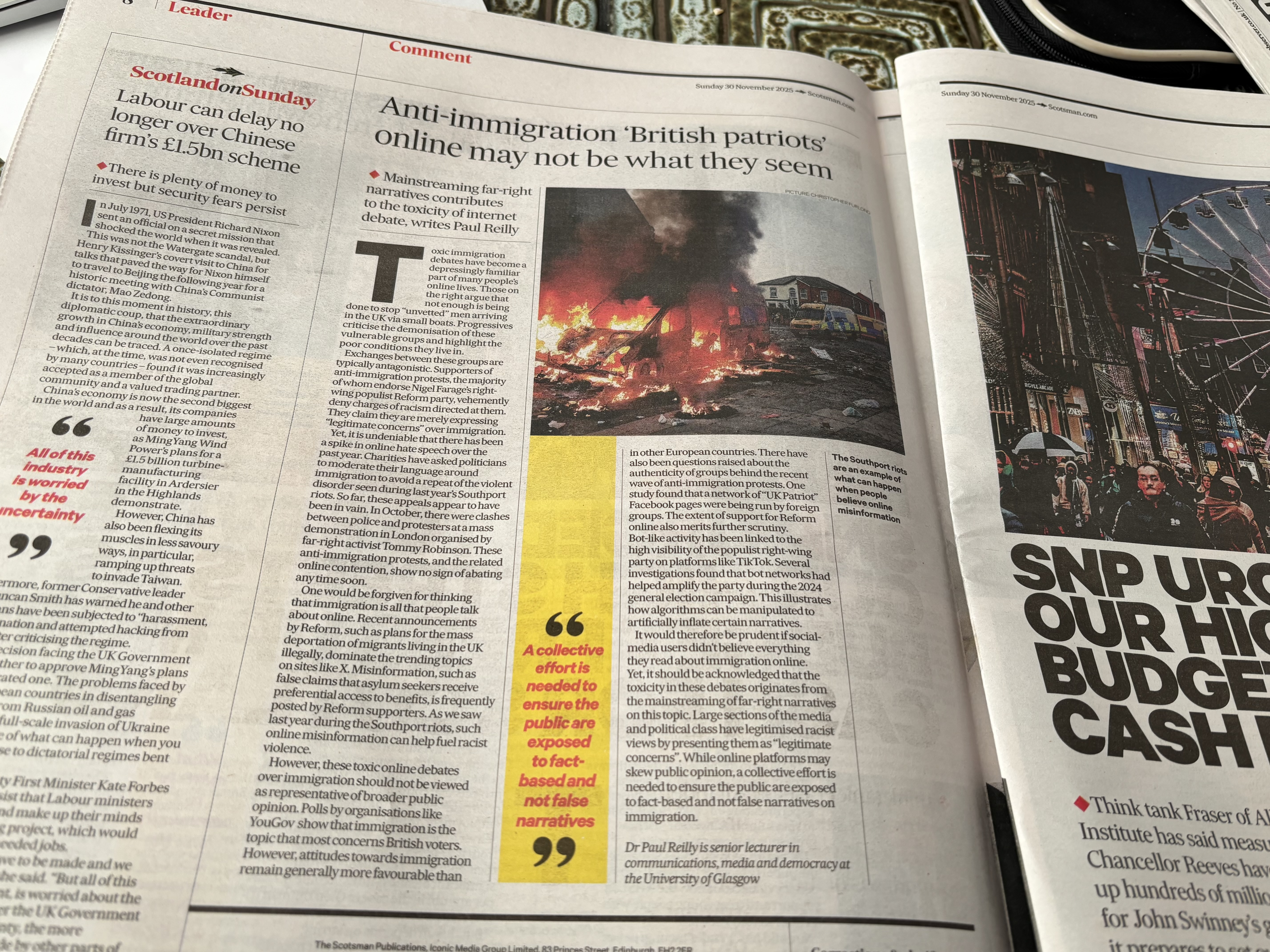
Yesterday I had an op-ed published in Scotland on Sunday. I discussed the toxic immigration debates on social media and the rise of Nigel Farage’s Reform party online. My argument was that we should be more sceptical of what we see online. There is already evidence that bots are used to amplify Reform’s talking points on this issue. The public is apparently obsessed with ‘small boats’ and ‘illegal immigration’. This is due to years of mainstreaming far-right narratives on this topic. I conclude with the argument that a collective effort is required. This effort must ensure that social media users are exposed to facts. It is essential they are not misled by false narratives on immigration.

The full text of the op-ed can be read here.

As always, many thanks to Charlotte Morris for helping arrange this. I also appreciate the editorial team at SoS for publishing it.

Invited presentation at event on social media and good relations in Northern Ireland

T:BUC Engagement Forum

Yesterday I was an invited speaker at a Together: Building a United Community (T:BUC) Engagement Forum event. The topic was ‘Social Media and its impact on Good Relations’.

I spoke about my ongoing research on social media, parades and protests in Northern Ireland (2012-current). I drew on the results of my book (Digital contention in a divided society), #Brexitriots study, and encyclopedia entry on belief echoes. I discussed how online platforms amplify mis-and disinformation that undermine community relations during contentious events.

My slides can be viewed below:

It was interesting to hear from the other panelists and to hear the questions and feedback from the audience.

Many thanks to Paul Killen and the NICRC for the invitation.

Presentations at MeCCSA 2025

This week I was at Edinburgh Napier University to attend the annual MeCCSA conference. The theme this year was ‘Identity and Belonging’, with a specific focus on how identities are mediated and mediate themselves.

First, I was part of a Glasgow University Media Group panel on the Cost of Living Crisis. I presented an overview of the key findings with Cairsti Russell and Gavin Hawkton (unfortunately Catherine Happer was unable to join us due to ill-health).

Key themes included the debate over the use of the word ‘crisis’. There was also a focus on the impact of austerity and cuts in public services on low-income households. Our results suggest that media coverage of the COLC prioritised business perspectives over those of civil society. Citizens are increasingly attracted to alternative news sources. The slides from the session can be viewed below:

These findings are from the GUMG’s forthcoming book ‘Bad News for the Cost of Living Crisis’. The book, edited by Catherine Happer, Alison Eldridge and me, will be published with Palgrave Pivot in December 2025.

My second paper was on my ongoing research on social media, parades and protests in Northern Ireland. I drew on my book Digital Contention in a Divided Society and article on #Brexitriots in my presentation. It explored hashtags as affective ritualised responses to contentious events in Northern Ireland. I examined who was behind these discursive formations online, and who benefited from this activity. The slides can be viewed below:

Thanks to everyone who attended the sessions. asked questions, and provided important feedback on the work.

The Herald op-ed on racist violence in Northern Ireland

Yesterday I had an op-ed published in the Herald (Glasgow). It discusses the racist rioting seen in Northern Ireland earlier this month.

I argued that politicians have to take responsibility for their role in producing a toxic political discourse about immigration. In towns like Ballymena and Larne, there was violence. Politicians framed anti-migrant demonstrations as representing the ‘legitimate concerns’ of local communities. Now, more than ever, we need a fact-based narrative on immigration. It should be anti-racist to prevent a repeat of these racist riots.

Many thanks to Charlotte Morris and the Herald for arranging this. The op-ed can be read in full here.

Publication: Article on #BrexitRiots published in International Journal of Communication

My article ‘The Blame Game? #Brexitriots as an affective ritualized response to civil disorder in Northern Ireland has been published in the International Journal of Communication.

This paper focuses on how the April 2021 violence in Northern Ireland were discursively framed on Twitter. I argue that #Brexitriots was an affective ritualised response to civil unrest in Northern Ireland. It demonstrated a lack of knowledge of the grievances fuelling this violence.

The abstract is below:

The protests and violence in Northern Ireland in April 2021 were nominally a manifestation of Loyalist anger at the “Irish Sea border” created as part of the deal that saw the United Kingdom leave the European Union. Social media were widely blamed for having amplified tensions surrounding the protests. This study explores how affective publics, mobilized on Twitter, responded to the “Brexit riots.” It does so by providing an overview of how online platforms are used during contentious episodes in divided societies, examining the background of the disorder, and presenting the results of a reflexive thematic analysis of #brexitriots tweets (N = 8287) posted between April 9 and April 13, 2021. Results indicate that #Brexitriots was an affective ritualized response from tweeters who appeared unaware of the manifold grievances of the protesters. They used these events as a source of partisan political expression, confirming their view that the United Kingdom’s departure from the European Union was a mistake.

I would like to thank Suay Özkula and Victoria Baskett for their feedback on an earlier draft of this study. Also, a special mention to Kady and the IJOC team for their editorial help.

The paper is published Open Access and can be read in full here

Op-ed published in Scotsman on the Rise of Far-Right Extremism in Scotland

Yesterday I had an op-ed published in The Scotsman. In ‘Social media isn’t solely to blame for rise of far-right’, I argue for a holistic approach. It’s too easy to pin the blame solely on online platforms that amplify hate and misinformation. Politicians need to dial down the rhetoric on issues like immigration. It’s time to focus on why right-wing extremism resonates with young people rather than solely blame social media algorithms.

Many thanks to Charlotte Morris for helping arrange this. It can be read in full here.

Participant in UNOCHA Debate: Enhancing Crisis Communication Strategies

Debate on social media and crisis communication, UNOCHA HNPW, 21 March

Next Friday (21 March) I will be an invited participant in a debate on social media and crisis communication. This event is organised by Asad Tahir from the University of Leicester and the Avoidable Deaths Network. It is part of the United Nations Office for the Coordination of Humanitarian Affairs (UNOCHA) #HumanitarianWeek.

Jamie Wardman (University of Leicester), Christian Morgner (University of Sheffield), and I will explore the opportunities of using online platforms. We will also evaluate the challenges that arise during crisis situations.

A synopsis of the event is below:

The objectives of this session include: 1) To maximize the visibility of crisis communication as an anticipatory action for reducing avoidable deaths by employing effective and proactive communication strategies; 2) To enhance awareness about avoidable disaster deaths among the audience as well as the organizers. The innovative idea of an engaging debate offers a unique opportunity for the audience and the organizers to learn from each other; 3) To provide a vibrant platform for communication experts, crisis leaders, NGOs, students, academics and researchers to share their informed insights about disaster deaths and crisis communication; 4) To discuss and deliberate about the scope and significance of crisis communication as an effective component of crisis preparedness to significantly reduce the number of avoidable deaths and people affected by disasters by 2030; 5) It is pertinent to highlight that ADN is part of the Sendai Framework’s Voluntary Commitments (SFVC) Platform. Our Voluntary Commitments to the UNDRR are inked until 2030, especially focusing on the first two targets of the Sendai Framework. Therefore, this session promises an opportunity to not only manifest our commitments to the UNDRR but also maximize the visibility of our continued endeavors at the UNOCHA’s Summit in Geneva; and 6) Above all, this interesting and innovative debate seeks to promote awareness and enhance knowledge about the theory and practice related to avoidable deaths and crisis communication strategies as an effective tool for crisis preparedness

There is still time to register for this event here

Exploring Digital Activism: Public Lecture at European University Rotterdam

Invited public lecture at European University Rotterdam, 18 February 2025

This week I am delighted to be an academic visitor at the European University Rotterdam. During this trip, I will deliver a public lecture entitled ‘From Doomscrolling to Activism/Action’. Chaired by Dr. Delia Dumitrica (EUR), activist and researcher Chris Julien and I will discuss the future of Digital Activism. We will explore this topic in an increasingly fragmented world. I will discuss the key findings from my book Digital Contention in a Divided Society (Manchester University Press, 2024).

A description of the event is below:

Do you know the feeling? Climate change, ongoing wars, rising hostilities. The world appears to be on fire and more polarized than ever, and it seems almost impossible to do something about it. How do we break this helpless feeling of despair? How can online feelings of empathy and care translate into real world action? And what is necessary for discontent to become successful political movements?

The event is co-organised by Delia and Lenya Slierendrecht from Studium Generale. It will be held at CB-4 (Theil Basement), European University of Rotterdam. The event timing is from 19:30 to 21:00 CET.

If you are in Rotterdam tomorrow (18 February), there is still time to register to this free event here.

Many thanks to Delia and Lena for the invite- should be a great discussion!

TikTok Under Trump: Euronews interview on the Influence of Tech Billionaires

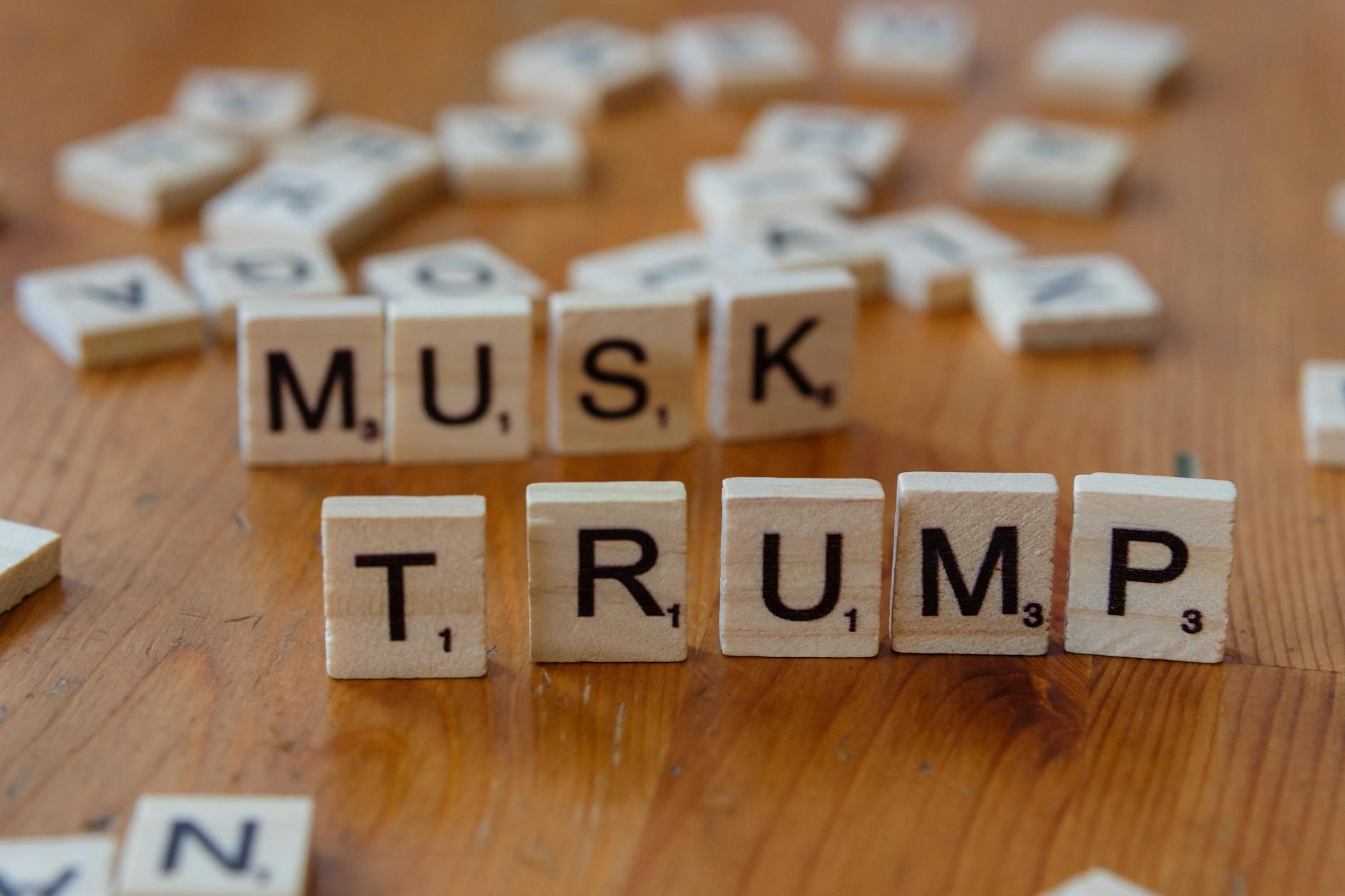
I was interviewed by Anna Desmarais for an article. It was published by Euronews on the future of TikTok under the Trump administration. I argued that tech ‘broligarchs’ like Elon Musk lack accountability when they decide what is ‘free speech’ or not. Their influence on public discourse presents a threat to democratic values. This is particularly concerning given their ability to censor content they disagree with.

Thanks to Anna for the interview, it can be read in full here.