On Wednesday I spoke to Hamish Morrison from The National about the list of far-right protests in Scotland circulated on social media. We discussed how far-right groups used apps like Telegram to organise, the threat of misinformation during the recent riots in England, and how best to respond to false information circulating online.
Thanks to Hamish and Charlotte Morris for the invitation. The article can be read here.
On Monday I was interviewed by Orla Barry for a segment on international public radio news show The World. We discussed the likelihood of sanctions being applied by the UK government to social media platforms who amplified misinformation during the ongoing civil unrest.
Many thanks to Orla for the invitation. The segment can be listened to here.
interview on BBC Scotland’s The Nine, 6 August 2024.
Last night I appeared on BBC Scotland’s The Nine to discuss the role of social media in the ongoing UK riots. I discussed the difficulty of removing hate speech and misinformation from platforms that are not considered publishers.
Many thanks to Charlotte Morris, Ben Russell and the team on The Nine for arranging the interview.
The interview can be viewed here (it begins at 24:30).
Yesterday I spoke to Sebastian Seibt from France 24 about the role of social media in the riots seen in English towns and cities over the past week.
We discussed the role of public figures, journalists and influencers in amplifying misinformation that contributed to the violence. I suggested that it was too early to tell whether Russian disinformation agents had played a key role in the spread of false information about the Southport attacker.
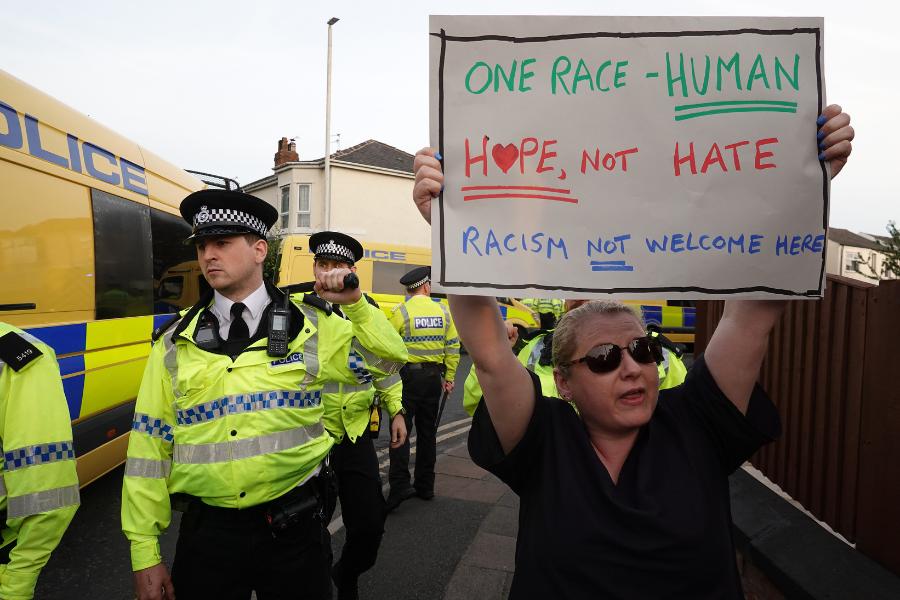
Image of counter-demonstrator in Southport, via HopenotHate
On Saturday I spoke to Andrew Peach on LBC News about the role of social media during the riots in Southport, London, Hartlepool and Sunderland over the past week. We discussed issues like the role of conspiracy theories and misinformation in inflaming tensions, and whether platforms can do more to remove harmful content.
Yesterday I participated in a segment on BBC Radio Ulster Talkback about the misinformation and the 2024 UK General Election. Presented by William Crawley, I joinedClaire Graham and Orna Young and to discuss how best to identify misinformation circulated via online platforms, how easy it is to do so, and the potential use of deepfake technologies to alter speeches made by politicians.
Yesterday I was interviewed by Alys Davies for a BBC News article on the All Eyes on Rafah image that has been heavily shared on Instagram over the past few days. I argued that the AI-generated image went ‘viral’ due to the fact it did not show graphic images of the victims of the Israeli attack, and its amplification by celebrities. However, activists and journalists on the ground might feel aggrieved at this ‘sanitised’ version of the attacks that left 45 dead and many more injured. Thanks to Alys for the invitation to speak about this issue.
I have written an essay for the University of Glasgow Social Sciences Hub on the role of social media in protests and disorder in divided societies. In the piece, I reflect on something I wrote about the 2011 English riots and consider how online platforms are used by citizens to frame contentious issues. I argue that the indirect effects of online incivility seen during divisive events can be detrimental for efforts to promote peace and reconciliation in divided societies.
Thanks to Andrew MacIver for the help in publishing this. It can be read in full here and you can buy a copy of Digital Contention in a Divided Society here.
We discussed the privacy concerns raised in relation to Threads, whether it can replace the immediacy and news of Twitter, and what politicians hope to gain from setting up accounts on the new platform.
A few selected quotes are below:
On the future for Twitter if Threads continues to grow in popularity:
“I do wonder if it doesn’t have the key functionality of Twitter, which is to break news and tofollow things, and that’s hashtag focused. To me, it probably has a limit in terms of how manypeople will give up on Twitter completely and move there. Unless Twitter does collapse and maybe that does happen“.
On whether people will migrate from Twitter to Threads in large numbers:
“I think it’s harder to pack up and move an entire group of people there [..] Particularly when they’re used to the kind of rhythms of Twitter and whether it’s following events or following things which are breaking“.
On why politicians might sign up to Threads:
“But there is a question mark there about these platforms, it’s as if almost every politician or party has to be on them because they think that’s where they’re going to reach younger people“
Yesterday I participated in a segment on BBC Radio Ulster Talkback about the future of Twitter under Elon Musk. Presented by William Crawley, I joined Brenda Gough and Andrew Pierce to discuss the future of microblogging site in the wake of users leaving for sites like Mastodon. We also how the moderation rules on non-profit sites compare to Twitter.
You can listen to the segment here (it begins at 38:29 and finishes at 56:51).
Many thanks to William, Claire and the Talkback team for the invitation to participate.




 Dr Paul Reilly
