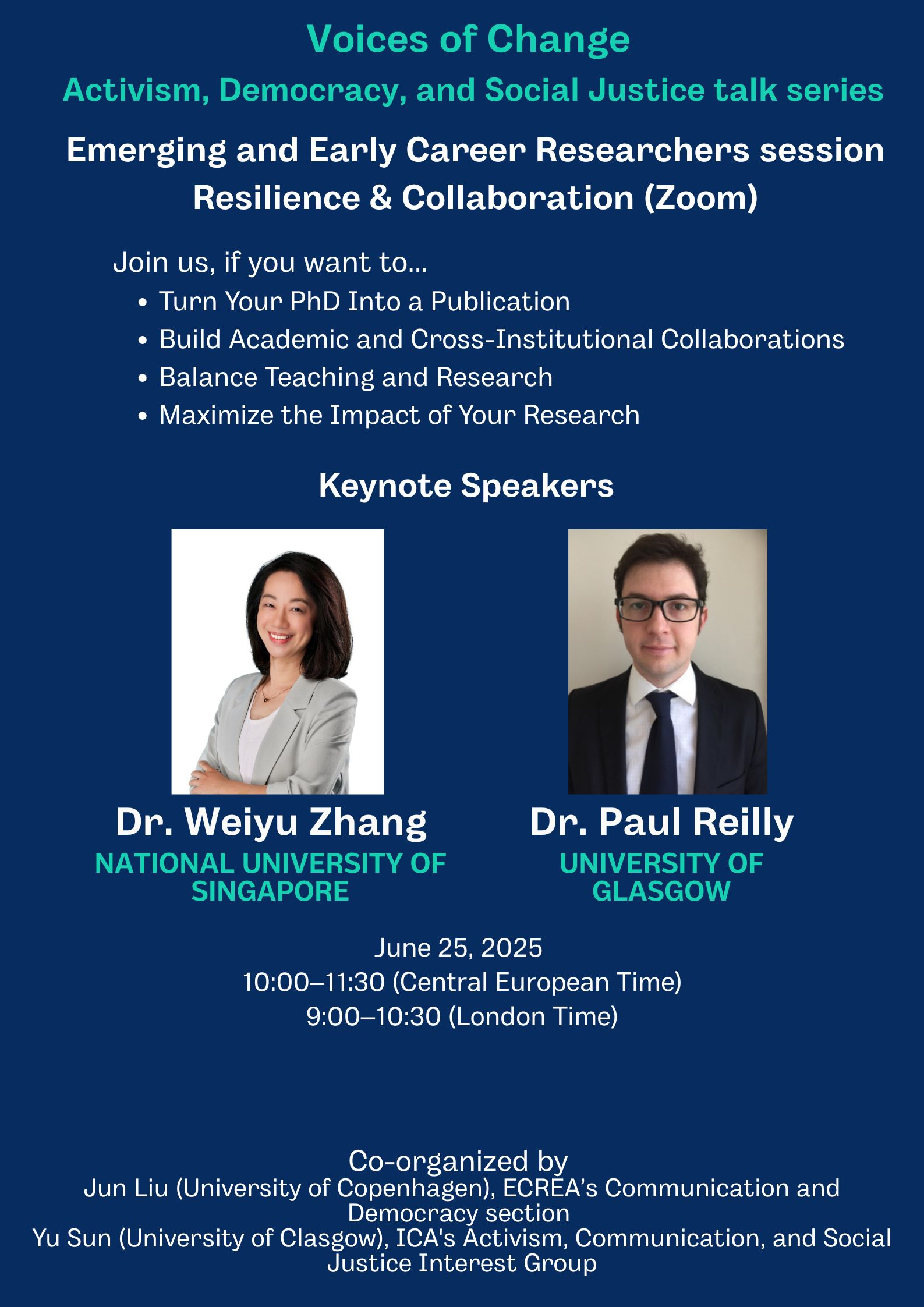
The focus of my talk will be on how to publish monographs as an early career researcher. I will provide some advice on how to convert PhD theses into books, including things to include in the proposal and how to write for audiences outside academia.
There will also be a Q&A for ECRs to ask questions about topics such as balancing research and teaching, building international research collaborations, and maximising the impact of research.
Many thanks to Jun Liu (University of Copenhagen) and Yu Sun (University of Glasgow) for the invitation.
My first paper is entitled ‘Watching over the watchers? Ethical dilemmas in qualitative studies of sousveillance on YouTube. Drawing on my previous work on ‘The Battle of Stokes Croft‘ and the union flag protests, I critique the notion that unaware participants are ‘fair game’ in online research. The abstract can be read in full here.
My second paper, co-authored with Suay Özkula, draws on our systematic review of empirical Digital Activism research between 2011 and 2018. We focus on how activists and social movements within the so-called Global South are represented within the field. The abstract can be read in full here.
If you are at the conference this week please do say hi – looks like a great programme!
an example of Don McCullin’s iconic photojournalism during the Troubles
Last year I wrote a blogpost on a project exploring how Instagram is used to share photographs of the Northern Irish Troubles. This morning I presented preliminary findings from this work at the 8th European Communication Conference organised by ECREA.
My talk was part of a panel entitled ‘Emotions, rituals and memories’, which should be made available later to watch on the conference platform.
The abstract for the paper is below:
Conflicting Memory and Social Media: Memorialising the Northern Irish Troubles on Instagram
Photosharing app Instagram provides unprecedented opportunities for distributing photographs challenging the ‘official memory’ of conflict. The ‘connective turn’ not only renders conflict photography searchable, but aggregates the memories of traumatised communities. This paper adds to the nascent literature in this area by exploring how Instagram is used to share photographs of the Northern Irish ‘Troubles,’ a low-intensity conflict that resulted in 3,600 fatalities and left many more bereaved, injured and traumatized. Twenty years after the Agreement, Northern Ireland remains a deeply divided society in which competing narratives over the conflict and its constitutional status remain deeply entrenched. This study explored the visual representation of these narratives on Instagram, with a specific focus on the type of images shared and the comments they generated from other Instagrammers. A content and visual framing analysis of 100 historical images tagged #thetroubleswas conducted between August and December 2019 in order to explore these issues. Results indicate that images of everyday life during the conflict, such as children playing in desolate urban landscapes, and British soldiers, typically depicted holding weapons against a backdrop of civil unrest, were the most prominent visual representations under this hashtag. Those shared by British army veterans depicting their experiences typically sparked a polarised debate between pro-British and pro-republican commenters on the origins of the conflict. While the affordances of Instagram broaden participation in processes of memorialization, they also lay bare the absence of a shared narrative on the violent past in ‘post-conflict’ societies such as Northern Ireland.


 Dr Paul Reilly