

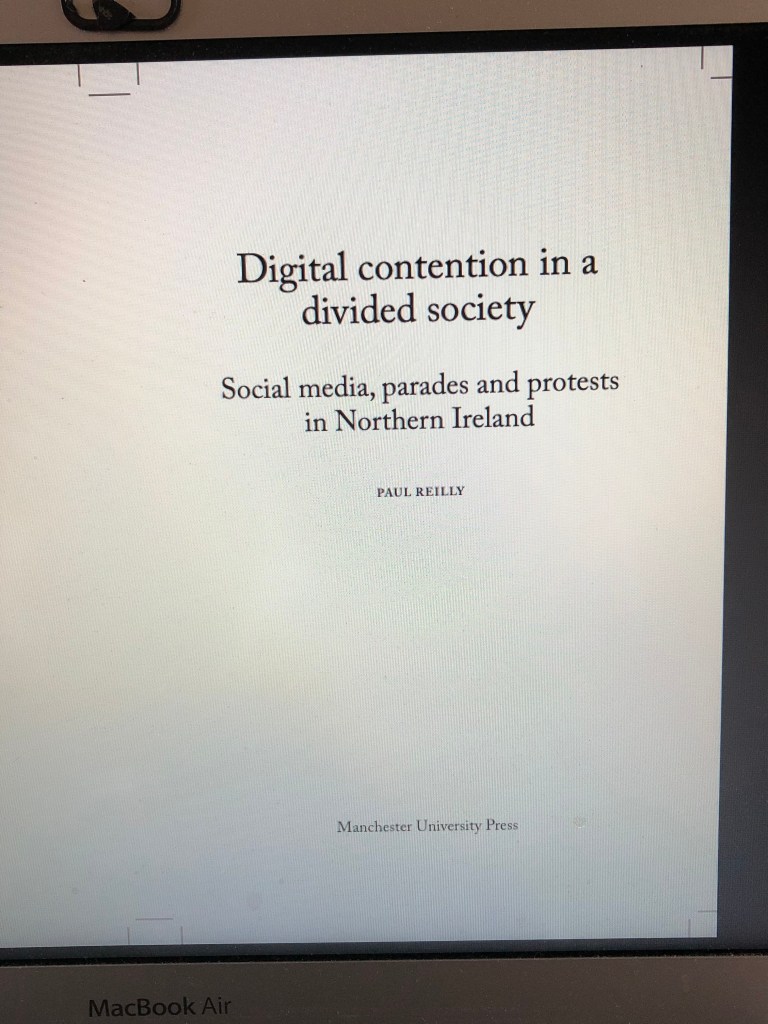
My new book Digital Contention in a Divided Society: Social media, parades and protests in Northern Ireland has been published today by Manchester University Press.
Here is a brief description of the book:
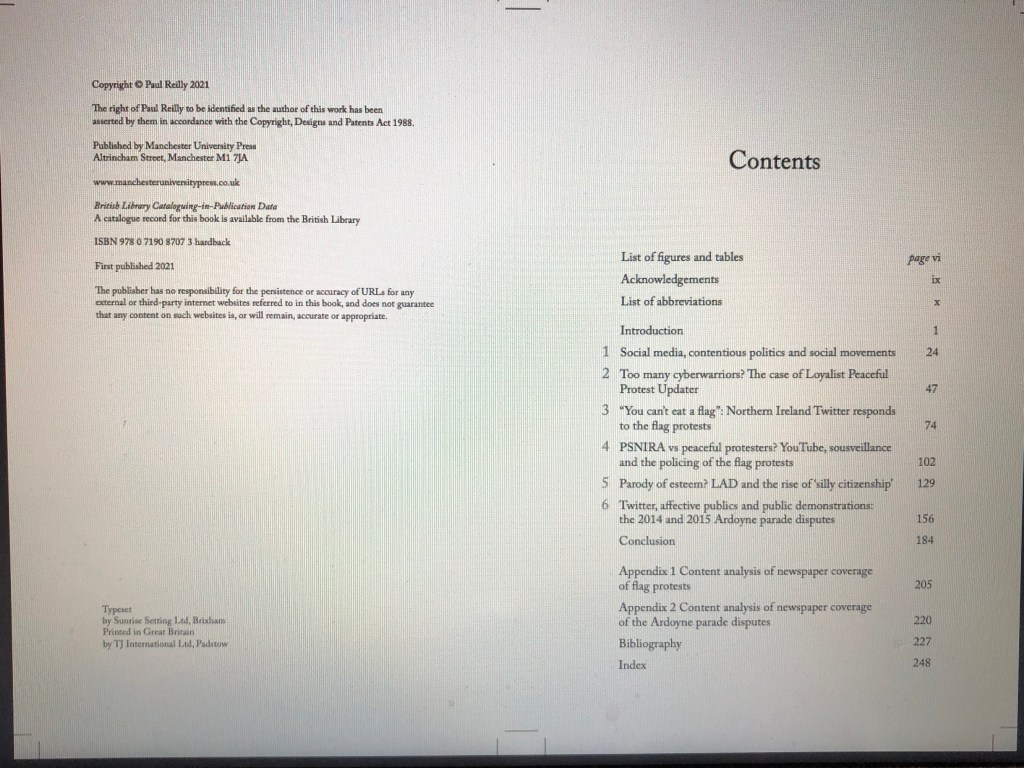
How are platforms such as Facebook and Twitter used by citizens to frame contentious parades and protests in ‘post-conflict’ Northern Ireland? What do these contentious episodes tell us about the potential of information and communication technologies to promote positive intergroup contact in the deeply divided society?
These issues are addressed in what is the first in-depth qualitative exploration of how social media were used during the union flag protests (December 2012-March 2013) and the Ardoyne parade disputes (July 2014 and 2015). The book focuses on the extent to which affective publics, mobilised and connected via expressions of solidarity on social media, appear to escalate or de-escalate sectarian tensions caused by these hybrid media events. It also explores whether citizen activity on these online platforms has the potential to contribute to peacebuilding in Northern Ireland.


Reviews of Digital Contention in a Divided Society
‘Much that is written about the politics of Northern Ireland is based on highly selective accounts of the available evidence. Reilly eschews this approach, subjecting the political use of social media to sustained critique in this empirically rich study. In so doing, he makes a very valuable contribution to scholarship.’
Phil Ramsey, Lecturer in the School of Communication and Media, Ulster University
‘A timely historical account cataloguing a rich collection of the author’s empirical research, the book evinces continuity in polarisation among Northern Irish communities online. Showing how the use of social media adds further complexity to community relations, for instance through the pointed concept of ‘silly citizenship’, Reilly meticulously dispels earlier techno-optimism while further contextualising the algorithmic power of social media.’
Dan Mercea, Reader in Media and Communication, City, University of London
‘While the darkest days of Northern Ireland’s ‘troubles’ are over, the divisions have left lasting scars and in the twenty-first century the competing interpretations of the conflict and the country’s constitutional status remain entrenched. Reilly’s work explores the contribution of digital citizenship to peacebuilding within this complex context. The comprehensive and engaging analysis explores how a society beset with deeply held prejudices form online communities, share content and can be misled by misinformation so contributing to a range of wider debates on the role of digital media. As with many studies Reilly identifies positives, such as Citizen Assemblies and accounts that scrutinize decision making, as well as the acts of ‘silly citizenship’ which satires sectarianism and can exacerbate divide. Reilly’s work is an important contribution to our understanding of digital politics, how platforms can be a force for good or ill depending on the motivations and behaviour of users, and how forms of digital citizenship can support or disrupt societal healing processes. Reilly’s study is a must read for scholars and students seeking to understand the complex roles which digital technologies play in socio-political life as well as for those seeking to understand the dynamics of present day Northern Ireland and how it might face the challenges of a post-Brexit world.’
Darren Lilleker, Professor of Political Communication, Bournemouth University
The book is available in both print and eBook format and can be ordered here.
I will be in conversation with John Coster (Doc Media Centre) at a book launch event organised by Manchester University Press on 29 January (1-2pm). For information on how to register, please see here


 Dr Paul Reilly