interview on BBC Scotland’s The Nine, 6 August 2024.
Last night I appeared on BBC Scotland’s The Nine to discuss the role of social media in the ongoing UK riots. I discussed the difficulty of removing hate speech and misinformation from platforms that are not considered publishers.
Many thanks to Charlotte Morris, Ben Russell and the team on The Nine for arranging the interview.
The interview can be viewed here (it begins at 24:30).
Yesterday I spoke to Sebastian Seibt from France 24 about the role of social media in the riots seen in English towns and cities over the past week.
We discussed the role of public figures, journalists and influencers in amplifying misinformation that contributed to the violence. I suggested that it was too early to tell whether Russian disinformation agents had played a key role in the spread of false information about the Southport attacker.
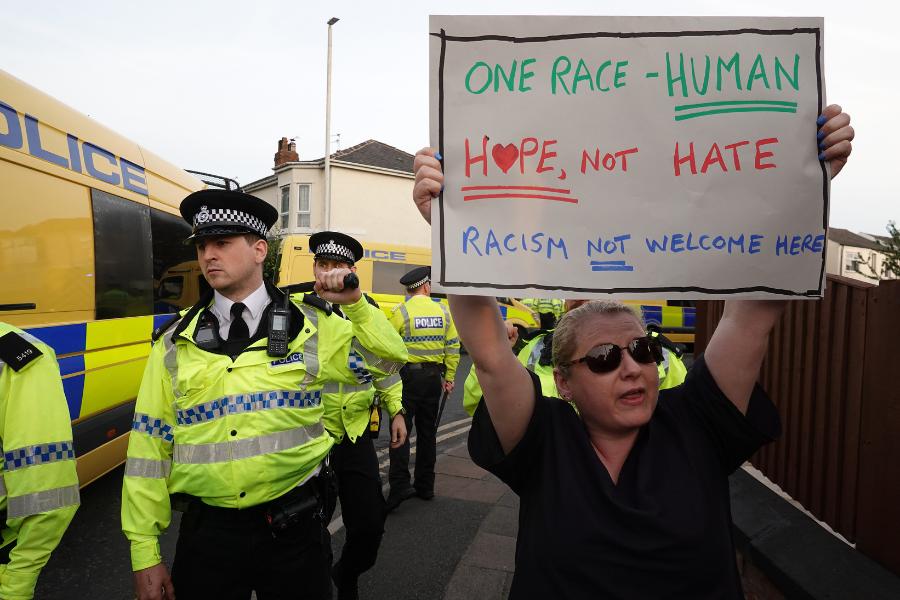
Image of counter-demonstrator in Southport, via HopenotHate
On Saturday I spoke to Andrew Peach on LBC News about the role of social media during the riots in Southport, London, Hartlepool and Sunderland over the past week. We discussed issues like the role of conspiracy theories and misinformation in inflaming tensions, and whether platforms can do more to remove harmful content.
In this piece, I analyse the role of social media misinformation in the Southport riots earlier this week. I explore how online platforms circulated false information alleging the attacker was Muslim, a migrant and a refugee.
I argue that while social media helped amplify tensions, their role should not be overblown. Politicians must also take some responsibility for their role in creating a toxic discourse surrounding immigration.
Many thanks to Avery Anapol for the invitation to write this piece.
I have an article in a new publication on the 2024 UK General Election edited by Dan Jackson, Julie Firestone, Emily Harmer, Einar Thorsen, Darren Lilleker, Katy Parry and Scott Wright. This rapid response report features 101 contributions from 130 UK and international academics .
Many thanks to the editors for the invitation to participate and all their hard work in producing this comprehensive report.
My article explores the Facebook ads paid for by the parties in Northern Ireland. I analyse who spent the most, who were the most prominent politicians, and the rhetoric deployed in these ads.
Suay Melisa Özkula and I were honoured to receive an award at the annual International Communication Association (ICA) conference in Australia today. Our paper ‘Where is the Global South? A Systematic Review of Regional Visibilities in Digital Activism Research’ received the Top Faculty Paper from the ICA’s Activism, Communication and Social Justice Interest Group.
Best Faculty Paper Award, ICA ACSJ 2024
Many thanks to the reviewers and the ACSJ team (Rasha, Hanan and Betty) for the award.
If you are at #ICA24 you can see Suay present our paper as part of the Digital Activism and Social Justice panel on Monday (3:00 PM – 4:15 PM; Surfer’s Paradise 1 Star L3).
Suay picking up our award at the ACSJ Business Meeting!
The abstract for the paper can be read below:
Where is the Global South? A Systematic Review of Regional Visibilities in Digital Activism Research
Recent scholarship has problematised the dominance of the Global North within communication research and called for de-westernisation to incorporate more cosmopolitan perspectives (Badr & Ganter, 2021; Bosch, 2022; Waisbord, 2022). While some scholars argue that a ‘decolonial turn’ in digital media research is occurring (Couldry &Mejia, 2021), it remains unclear whether this is also the case in digital activism (abbreviated: DA) research. Extant scholarship suggests that ‘Western’ social media platforms and activism from Global North countries are over-represented within the field (e.g., Mahl et al., 2022; Ruess et al., 2021) including in research methods applied in these (Bosch, 2022; Schoon et al., 2020). This has, for example, been problematised within African (Moyo & Mutsvairo, 2018, Wasserman, 2018) and Latin-American contexts (Gómez-Cruz, et al., 2023; Medrado & Rega, 2023).
Other studies have drawn attention to the western-centric nature of information and communication technologies, as demonstrated by the countries from which their providers or designers originate (Arora, 2019). Much of this critical research has framed these digitally mediated exploitations as a manifestation of ‘data colonialism’, a concept describing how user data are processed at scale to produce economic value (Couldry & Mejias, 2021, 2019). In the same vein, cognate theories of databased geographies’ (Arora, 2019), ‘technocolonialism’ (Madianou, 2022), and ‘neocolonial media culture’ (Bosch, 2022, p. 299) illustrate how the growth of “big data” has often been linked to the exploitation of those residing in the Global South as knowledge about those regions is typically produced through the lens and paradigms of the Global North.
The evolution of ‘digital methods’ should theoretically create more opportunities for DA research on the Global South. These are typically software-based methods that draw on natively digital objects, methods, and data (Rogers, 2019; Venturini et al., 2018). However, it remains to be seen whether their use correlates with more representative DA research. The often prohibitive cost of these software packages, as well as their configuration for the study of “Western” social media platforms such as Facebook, Twitter/X, and Instagram, suggest that they may primarily intended for privileged Global North researchers.
While previous meta-analyses and systematic reviews have explored either the relationship between ICTs and political engagement (e.g. Ruess et al., 2021; Boulianne et al., 2023) or the platforms being studied in DA research (anonymised), there has been no research to date exploring the geographic foci of empirical DA research, including in relation to digital methods specifically. This paper sets out to address this gap by presenting the results of a systematic review of DA research published between 2011 and 2018 (N=315). Specifically, it explores the representation of Global South and semi-periphery case studies in DA journal articles, the methods and platforms that feature in this body of research, and where the author(s) were based at the time of publication.
Yesterday I participated in a segment on BBC Radio Ulster Talkback about the misinformation and the 2024 UK General Election. Presented by William Crawley, I joinedClaire Graham and Orna Young and to discuss how best to identify misinformation circulated via online platforms, how easy it is to do so, and the potential use of deepfake technologies to alter speeches made by politicians.
Yesterday I was interviewed by Alys Davies for a BBC News article on the All Eyes on Rafah image that has been heavily shared on Instagram over the past few days. I argued that the AI-generated image went ‘viral’ due to the fact it did not show graphic images of the victims of the Israeli attack, and its amplification by celebrities. However, activists and journalists on the ground might feel aggrieved at this ‘sanitised’ version of the attacks that left 45 dead and many more injured. Thanks to Alys for the invitation to speak about this issue.
Delighted to be involved in organising this great workshop on researching social media research. Please do share widely and submit!
Researching Social Media After the API: A One-Day Workshop
University of Liverpool (and online)
Wednesday 19th June 2024 (exact times to be confirmed!)
Deadline for submission: Friday 24th May 2024
In the recent past, social media platforms became more open about working alongside academic researchers and crucially, enabling academic access to their data in order to facilitate political communication research (and many other forms of research besides). However, this has been dramatically reversed in recent years in what Axel Bruns (2019) has referred to as the “APIcalyspe”. Both Meta and X (formerly Twitter) have withdrawn or sought to restrict access to their platforms for academic research by making it prohibitively expensive. The discipline now stands at a crossroads (Bruns, 2019). Either accept and adapt to the new access arrangements, most likely to the detriment of the scope, volume, and overall quality of the research, or consider methodological innovations and workarounds to examine these platforms central to our everyday existence. To this end, we would like to invite contributions to a one-day workshop to be held in hybrid format (online and in person, at the University of Liverpool), to discuss how we might continue to research social media platforms under these difficult conditions.
Potential topics could include (but are not restricted to):
– researching the ‘black box’ (documenting and analysing communication on closed platforms such as WhatsApp/Discord/ etc.
– The significance of small-N case studies
– Researching dead or declining platforms
– The ethics of collaborating with technology companies
– Researching content moderation practices
– Practical reflections on specific methods
– Qualitative approaches
Please submit a 300 word abstract outlining the topic of your proposed contribution along with your name and contact information. Please also indicate if you would prefer to contribute online or in person. Abstracts addressing political research topics (broadly defined) will be prioritized. Abstracts and queries should be sent to Emily Harmer: E.Harmer@liverpool.ac.ukby 24th May 2024.
The workshop is funded by DigiPol: Centre for Digital Politics, Media and Democracy at the University of Liverpool. We have a small pot of money to assist with travel costs to attend in person. Priority will be given to PGRs or unwaged/precariously employed colleagues. If you would like to be considered for a travel bursary, please indicate this in your submission so we can assess demand.
Organisers: James Dennis (University of Portsmouth), Emily Harmer (University of Liverpool), Liam McLoughlin (University of Liverpool), Paul Reilly (University of Glasgow) and Ros Southern (University of Liverpool).
Deconstructing societal threats during times of deep mediatization, Routledge, 2023.
A few weeks ago we had the long overdue launch event for (De)constructing Societal Threats During Times of Deep Mediatization. Organised by the IAMCR Crisis, Security and Conflict Communication Working Group, we were delighted to be joined by three of the authors (Minos, Olivia and Gregory) for a discussion of their respective chapters. The video can be viewed below:
Recording of book launch event, 16 April 2024
Thanks to our presenters and attendees for the great debate. A description of the book is below.
De)constructing Societal Threats During Times of Deep Mediatization
This book explores how both elite and non-elite actors frame societal threats such as the refugee crisis and COVID-19 using both digital and traditional media. It also explores ways in which the framing of these issues as threatening can be challenged using these platforms.
People typically experience societal threats such as war and terrorism through the media they consume, both on and offline. Much of the research in this area to date focuses on either how political and media elites present these issues to citizens, or audience responses to these frames. This book takes a different approach by focusing on how issues such as the refugee crisis and the COVID-19 pandemic are both constructed and deconstructed in an era of hybrid media. It draws on a range of traditional and innovative research methodologies to explore how these issues are framed as ‘threats’ within deeply mediatized societies, ranging from content analysis of newspaper coverage of the Macedonian name dispute in Greece to investigating conspiratorial communities on YouTube using Systemic Functional Linguistics. In doing so, this book enriches our understanding of not only how civil and uncivil actors frame these issues, but also their impact on societal resilience towards future crises.
(De)constructing Societal Threats During Times of Deep Mediatization will be a key resource for academics, researchers, and advanced students of Communication Studies, Media Studies, Journalism, Cultural Studies, Research Methods, Sociology and Politics.
The chapters included in this book were originally published as a special issue of The Communication Review. Many thanks to our authors for their excellent contributions, which are listed below:
1. Framing the Macedonian name dispute in Greece: Nationalistic journalism and the existential threat Minos-Athanasios Karyotakis
2. The “ultimate empathy machine” as technocratic solutionism? Audience reception of the distant refugee crisis through virtual reality Zhe Xu and Mengrong Zhang
3. A systemic functional linguistics approach to analysing white supremacist and conspiratorial Ddscourse on YouTube Olivia Inwood and Michele Zappavigna
4. Internet regulation and crisis-related resilience: From Covid-19 to existential risks Gregory Asmolov







 Dr Paul Reilly
