Invited talk on social media, parades and protests at Nottingham Trent-28 April 1-2pm

Centre for Study of Inequality, Culture and Difference, NTU.

I will be giving an invited talk at the Research Centre for the Study of Inequality, Culture and Difference at Nottingham Trent University on 28 April (1-2pm). Many thanks to Ben Taylor, Colin Alexander and Laura Coffey-Glover for the invitation.

Details of the talk can be found below:

The NTU Research Centre for the Study of Inequality, Culture and Difference is delighted to welcome Dr Paul Reilly from the University of Sheffield 2-3pm BST on Wednesday 28th April, who will be giving a talk on Social media, parades and protest in a Divided Society: Reflections from post-conflict Northern Ireland.

Abstract:

How are platforms such as Facebook and Twitter used by citizens to frame contentious parades and protests in ‘post-conflict’ Northern Ireland? What do these contentious episodes tell us about the potential of information and communication technologies to promote positive intergroup contact in the deeply divided society? In this paper, I will explore these issues through the first in-depth qualitative exploration of how social media were used during the union flag protests (December 2012-March 2013) and the Ardoyne parade disputes (July 2014 and 2015). I examine the extent to which affective publics, mobilised and connected via expressions of solidarity on social media, appear to escalate or de-escalate sectarian tensions caused by these hybrid media events. I conclude by examining whether citizen activity on these online platforms has the potential to contribute to peacebuilding in divided societies such as Northern Ireland. Bio: Dr. Paul Reilly is Senior Lecturer in Social Media & Digital Society at the University of Sheffield. His research focuses on social media sousveillance, digital activism and the use of digital media to promote better community relations in divided societies. He has written two books on the role of digital media in conflict transformation in Northern Ireland (Framing the Troubles Online and Digital Contention in a Divided Society, both with Manchester University Press). His work has also been published in a number of journals including First Monday, Information, Communication & Society, Journalism, New Media & Society, and Policy & Internet.

There is no registration for the seminar, and you can access it using the link below:

Click here to join the meeting

 Meeting options

Essay on role of social media in Northern Ireland riots

I have an essay in Human:Putting the Social into Science on the role of social media in the recent riots in Northern Ireland. It begins by exploring the factors that have underpinned the protests and related violence seen in Northern Ireland over the past two weeks, including the border created down the Irish Sea by the Northern Ireland Protocol and loyalist accusations about ‘two-tier policing’ in the wake of the PPS decision not to not to recommend any prosecutions for republicans who broke COVID rules during the funeral of senior PIRA member Bobby Storey in June 2020. Like the flag protests eight years ago, these street protests have also articulated increasing loyalist dissatisfaction with the Stormont Assembly and the peace process in general.

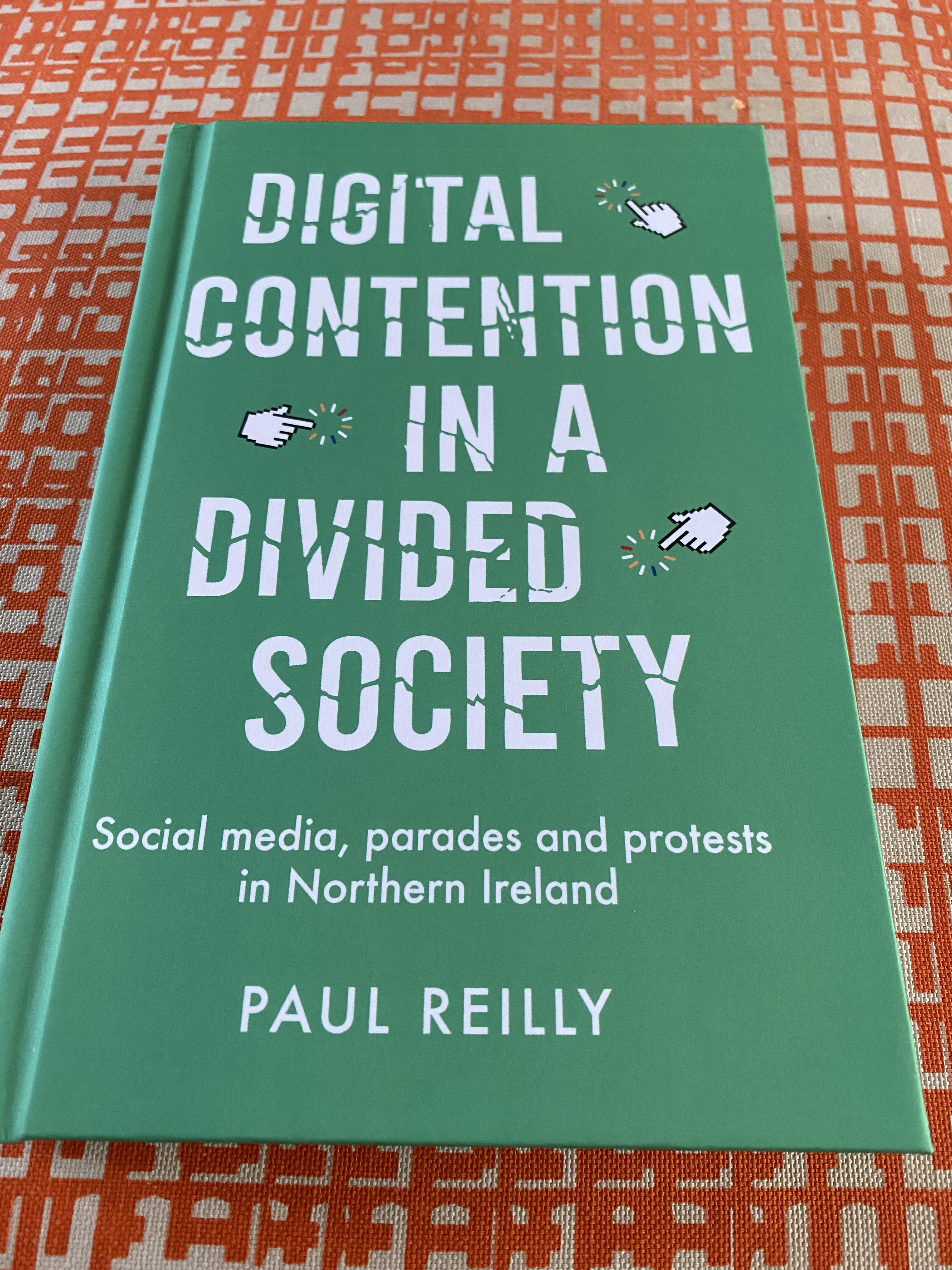
Drawing on my recently published book Digital Contention in a Divided Society, I argue that there are comparisons to be made in terms of how online platforms were used during the flag protests. Messages calling for loyalists to “shut down Northern Ireland” have reverberated around Facebook, Twitter, and WhatsApp. Videos recorded on smartphones showing the effects of the violence in interface areas have again become a focal point for the anger of online commentators. Mis-and disinformation is once again spreading via these platforms, as demonstrated by messages emanating from false flag accounts urging loyalist youths to “earn their strips” [sic] by engaging in violence. While social media may not be ‘fuelling’ these protests, the speed with which such information circulates presents a formidable challenge to those seeking to keep these demonstrations peaceful. Ultimately, political leadership is required if Northern Ireland is to avoid a contentious marching season this summer. 

Thanks to Laura Lightfinch and Victoria Wood for their help with this. The piece can be read here

VIEWdigital Review of Digital Contention in a Divided Society

Book review published in View Digital, 12 April 2021

The first review of Digital Contention in a Divided Society has been published in VIEWdigital this week. Some excerpts are below:

“Dr Reilly’s book highlights the need for ongoing discussions on the role of digital media in societies such as Northern Ireland, which face deep divisions. It is a place where contentious policies developed at polished tables of ministers and civil servants can result in a young person throwing a petrol bomb at a so called ‘peace wall’.

“It is an important addition to research on digital disinformation and misinformation in a society were conflict and division remain worryingly close to the surface”.

Digital Contention in a Divided Society, out now

I am very grateful to Una Murphy for this very generous review and to both her and Brian Pelan for publishing this piece.

It can be read here

Digital Contention in a Divided Society is out now and can be purchased in eBook and hardback formats here

New article on #PorteOuverte published in Social Media + Society

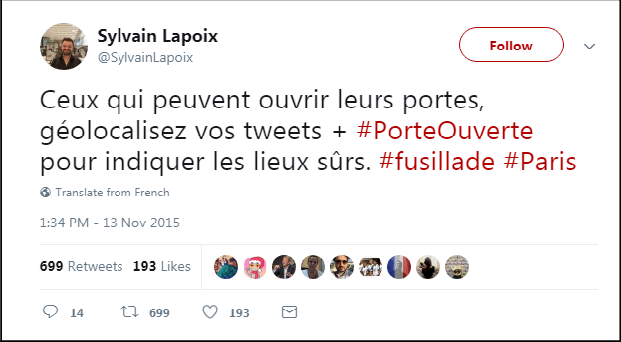
#PorteOuverte Tweet from journalist Sylvain Lapoix, 13 November 2015

Dr. Stefania Vicari and I have a new article out in Social Media + Society today. Entitled Organisational hashtags during times of crisis: Analysing the broadcasting and gatekeeping dynamics of #PorteOuverte during the November 2015 Paris Terror Attacks, the paper presents one of the first empirical studies of the ‘open door’ hashtag. Funded as part of the EU Horizon 2020 project IMPROVER, this social network analysis explores how these dynamics evolved as the attacks unfolded on 13 November 2015.

The abstract is below:

Twitter hashtags allow citizens to share vital information and make sense of acute crisis events such as terrorist attacks. They also enable those watching from afar to express their sympathy and solidarity with the victims. Perhaps the most well-known of these has been #PorteOuverte (translated into English as ‘Open Door’), first used during the November 2015 terrorist attacks in Paris before re-emerging during subsequent atrocities in Brussels (March 2016) and Nice (July 2016). The hashtag was originally created by journalist Sylvain LaPoix in order to connect those in Paris looking for somewhere to stay with those able to offer them refuge, before reaching an international audience courtesy of its amplication by public figures and citizens based overseas. This paper adds to this emergent literature by analysing the networked gatekeeping dynamics of #PorteOuverte during the Paris terror attacks. It does so by reviewing the literature on Twitter hashtags and acute crisis events, exploring how Twitter was used during the Paris terror attacks, and presenting the results of a Social Network Analysis (SNA) of 399,256 #PorteOuverte tweets posted as the attacks unfolded on 13 November 2015. Results indicate that professional journalists were key broadcasters during four identified peaks within #PorteOuverte, helping to promote the informational hashtag and connect those directly affected. However, citizens and bloggers played an increasingly important gatekeeping function in the aftermath of events such as the Bataclan siege in Paris. 

Thanks to the two reviewers for their thoughtful feedback, as well as Prof. Zizi Papacharissi and the SM+ S team for helping with the publication. The paper is available to read open access here

MeCCSA Policy network report in Three: d newsletter

MeCCSA Policy Network

Dr. Phil Ramsey (Ulster University) and I have published a report on behalf of the MeCCSA Policy Network in the latest edition of Three: d, the newsletter of the Media, Communication & Cultural Studies Association. We summarise some of the key discussion points from our recent event  ‘Platform politics, online harms and future research directions’, which featured invited presentations from Professor Lina Dencik (Cardiff University), Professor Sonia Livingstone (LSE), Alaphia Zoyab (Reset.tech) and Eleonora Mazzoli (LSE).

Article written with Phil Ramsey in latest edition of Three: d, March 2021

Thanks to the Policy Network team Professor Jonathan Hardy (UAL) and Dr. Maria Michalis (Westminster) for their hard work organising this seminar series and their assistance in preparing the report.

The article can be read online here

Invited seminar at University of Westminster, 4 March

Peace on Facebook, University of Westminster seminar, 4 March 2021 (17:00-19:00)

I am giving an invited seminar at the Communication and Media Research Institute at the University of Westminster tomorrow. Full details on the event are below:

Paul Reilly (University of Sheffield) – Problematising Social Media as Spaces for Intergroup Contact in Divided Societies

About this Event

4 March 2021

17:00-19:00

Register here

Peace on Facebook? Problematising Social Media as Spaces for Intergroup Contact in Divided Societies

As far back as the late sixties, renowned peace theorist Johann Galtung (1967) predicted that the rapid growth of new media technologies would favour associative rather than dissociative approaches towards peacebuilding. The assumption was that strategies to keep antagonists apart would likely fail due to the development of more efficient means of communication bringing them closer together. This resonates with the rhetoric employed by Peace on Facebook, a project created by the social media giant in partnership with Stanford University, which claimed that the platform provided space for dialogue between social groups traditionally divided along ethnic or sectarian lines. This contribution critically evaluates these claims by examining the potential contribution of social media platforms to peacebuilding in divided societies. It does so by reviewing the literature on social media peacebuilding initiatives and assessing whether these platforms constitute shared spaces in which positive relationships between members of antagonistic groups can be built in deeply divided societies. 

The analysis presented in this seminar suggests that the prospects for peace and positive intergroup contact in such societies are unlikely to be advanced through unstructured citizen activity on social media. These platforms amplify content that reinforces tribalism and political partisanship, thus making it harder to promote reconciliation between antagonists in divided societies. Drawing primarily on the case of Northern Ireland, a society still transitioning out of a thirty-year ethno-nationalist conflict, Paul Reilly suggests that the negative stereotyping of outgroups on social media militates against one of the key tenets of reconciliation, namely that citizens treat each other as individuals rather than anonymous members of the ‘other’ community. Therefore, ‘supervised’ online contact projects, revolving around the use of non-commercial platforms and culminating in face-to-face communication, are much more effective in building peace than the contact facilitated by online platforms such as Facebook.

Digital Contention in a Divided Society, out now.

I will draw on research conducted for my new book Digital Contention in a Divided Society.

I have been given a discount code which I can share, so please email me (p.j.reilly@sheffield.ac.uk) or DM me on Twitter (@PaulJReilly) if you want to purchase a copy. 

DCU Book talk today and Westminster Seminar 4 March

Digital Contention in a Divided Society, out now

Digital Contention in a Divided Society was published a few weeks ago. I have been given a discount code which I can share, so please email me (p.j.reilly@sheffield.ac.uk) if you want to purchase a copy. 

Sheffield University have recently published a piece highlighting some of the book’s key findings here

I will be doing a book talk today (25 February), as part of the Interdisciplinary Digital Research Group‘s seminar series at Dublin City University. Many thanks to Tanya Lokot for the invitation and organising the talk. Full details are provided below:

Speaker: Dr Paul Reilly (University of Sheffield)

Book talk: Digital Contention in a divided society: social media, parades and protests in Northern Ireland (Manchester University Press, 2021)

Date/time: 25 February, 2021, 4:00-5:00pm GMT

How are platforms such as Facebook and Twitter used by citizens to frame contentious parades and protests in ‘post-conflict’ Northern Ireland? What do these contentious episodes tell us about the potential of information and communication technologies to promote positive intergroup contact in the deeply divided society?

Register to attend this event (via Zoom) here 

I am also giving an invited seminar at the Communication and Media Research Institute at the University of Westminster next week. Full details on the event are below:

Paul Reilly (University of Sheffield) – Problematising Social Media as Spaces for Intergroup Contact in Divided Societies

About this Event

4 March 2021

17:00-19:00

Register here

Peace on Facebook? Problematising Social Media as Spaces for Intergroup Contact in Divided Societies

As far back as the late sixties, renowned peace theorist Johann Galtung (1967) predicted that the rapid growth of new media technologies would favour associative rather than dissociative approaches towards peacebuilding. The assumption was that strategies to keep antagonists apart would likely fail due to the development of more efficient means of communication bringing them closer together. This resonates with the rhetoric employed by Peace on Facebook, a project created by the social media giant in partnership with Stanford University, which claimed that the platform provided space for dialogue between social groups traditionally divided along ethnic or sectarian lines. This contribution critically evaluates these claims by examining the potential contribution of social media platforms to peacebuilding in divided societies. It does so by reviewing the literature on social media peacebuilding initiatives and assessing whether these platforms constitute shared spaces in which positive relationships between members of antagonistic groups can be built in deeply divided societies. 

The analysis presented in this seminar suggests that the prospects for peace and positive intergroup contact in such societies are unlikely to be advanced through unstructured citizen activity on social media. These platforms amplify content that reinforces tribalism and political partisanship, thus making it harder to promote reconciliation between antagonists in divided societies. Drawing primarily on the case of Northern Ireland, a society still transitioning out of a thirty-year ethno-nationalist conflict, Paul Reilly suggests that the negative stereotyping of outgroups on social media militates against one of the key tenets of reconciliation, namely that citizens treat each other as individuals rather than anonymous members of the ‘other’ community. Therefore, ‘supervised’ online contact projects, revolving around the use of non-commercial platforms and culminating in face-to-face communication, are much more effective in building peace than the contact facilitated by online platforms such as Facebook.

Press release and Dublin City University book talk

Digital Contention in a Divided Society was published on 19 January 2021.

Digital Contention in a Divided Society was published a few weeks ago. I have been given a discount code which I can share, so please email me (p.j.reilly@sheffield.ac.uk) if you want to purchase a copy.

Sheffield University have recently published a piece highlighting some of the book’s key findings here

I will be doing a book talk on 25 February, as part of the Interdisciplinary Digital Research Group‘s seminar series at Dublin City University. Many thanks to Tanya Lokot for the invitation and organising the talk. Full details are provided below:

Speaker: Dr Paul Reilly (University of Sheffield)

Book talk: Digital Contention in a divided society: social media, parades and protests in Northern Ireland (Manchester University Press, 2021)

Date/time: 25 February, 2021, 4:00-5:00pm GMT

How are platforms such as Facebook and Twitter used by citizens to frame contentious parades and protests in ‘post-conflict’ Northern Ireland? What do these contentious episodes tell us about the potential of information and communication technologies to promote positive intergroup contact in the deeply divided society?

Register to attend this event (via Zoom) here 

Essay on social media and intergroup contact in divided societies published in Cypriot magazine Gaile

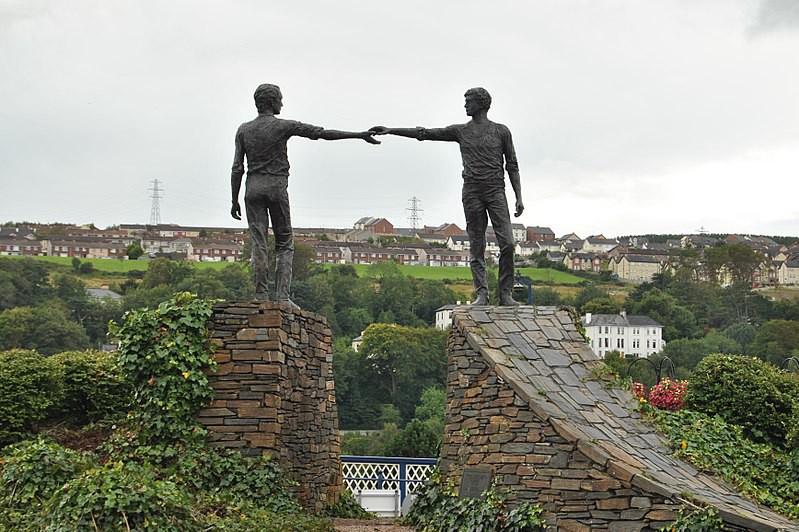
“Hands Across the Divide” sculpture in Derry, from Wikimedia Commons

My essay ‘Peace on Facebook? Online Platforms in post-conflict societies‘ has been published in Turkish by the Cypriot magazine Gaile. In this piece I evaluate the role of platforms such as Facebook and Twitter in facilitating intergroup contact in divided societies such as Northern Ireland. I also draw on some of the findings from my new book Digital Contention in a Divided Society, which was published last week.

The Turkish language version of my article can be read here

BBC Radio Derby interview on social media and ‘fake news’

Image: Facebook/Mirror

Yesterday I was interviewed by Andy Twigge on Breakfast on BBC Radio Derby about social media and ‘fake news’. This was in response to a photoshopped image of a road sign in Burton which had circulated on Facebook, before being reported in national media outlets like the Daily Mail and the Mirror. We discussed the reasons why people share ‘fake news’, how we should respond to this, and whether we need a ‘cooling off’ period before posting content online.

Thanks to Andy, Jonathan and the BBC Radio Derby team for the interview. It can be accessed here