In a wide-ranging conversation, we reflected on the role of media in how we remember conflict, some of the key themes in papers presented at our recent workshop in Glasgow, and the horrific events unfolding in Gaza.
Many thanks to John for the invitation and the engaging chat (as always!). The interview can be viewed below:
My second book Digital Contention in a Divided Society is due out in paperback on 26 March 2024. It will include a new chapter that explores the role of online platforms in contentious events between 2016 and 2023. It will be on sale for £20 (much more affordable than the hardback version).
Many thanks to Rob Byron and the Manchester University Press team for their help in bringing this to fruition. I am also told there may be a new cover- more on this soon.
I am hoping do do some in-person book talks this time (when the book was launched in 2021 this wasn’t possible due to COVID-19 regulations). I will post details of these on here when they are confirmed. If you are interested in hosting one of these talks then please do contact me (paul.reilly@glasgow.ac.uk).
The updated version of Digital Contention can be preordered here
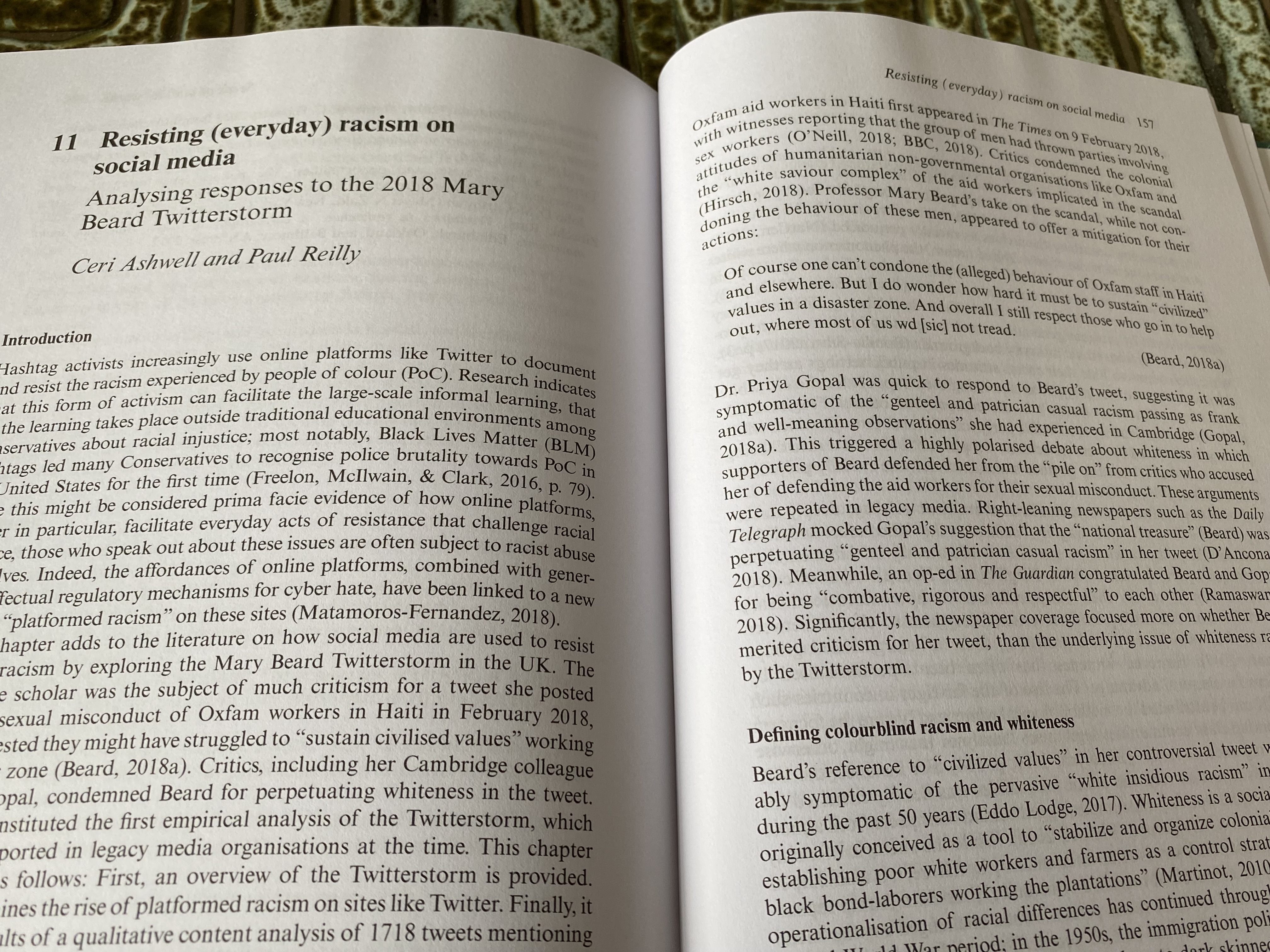
Ceri Ashwell and I have a chapter in the book based on our work on the Mary Beard Twitterstorm (see here for an article we previously published in Information, Communication & Society).
The title and abstract for the chapter are below:
Resisting (everyday) racism on social media: Analysing responses to the 2018 Mary Beard Twitter-storm
Big tech companies like Twitter have often been accused of not doing enough to address online hate speech. The algorithms and designs of social media have facilitated new forms of platformed racism in countries such as Australia and the United Kingdom (UK). While they undoubtedly amplify cyber hate, these online platforms also constitute important spaces in which people of colour (PoC), and their allies, can challenge colorblind racism and white privilege within contemporary societies. This chapter uses the 2018 Mary Beard Twitterstorm to explore how Twitter is used by activists to both highlight and counteract these tropes. The Cambridge scholar was heavily criticised by anti-racist activists for a tweet which appeared to condone the sexual misconduct of Oxfam aid workers in Haiti following an earthquake in January 2010. Her reference to the difficulty of ‘sustaining civilised values’ in the disaster zone was considered prima facie evidence of her whiteness and privilege. Researchers of colour, such as Beard’s Cambridge colleague Dr. Priya Gopal used the tweet to reflect on the ‘casual racism’ they experienced working in UK Higher Education institutions. These acts of resistance towards racial inequality and injustice within the academy led to Gopal herself being subject to much abuse and trolling from Beard’s supporters. This paper sets out to explore whether these acts of resistance can facilitate informal learning about issues pertaining to white privilege and frailty in countries such as the UK. It does so by reviewing the literature on social media and whiteness, providing background on the Mary Beard Twitterstorm, and presenting the results of a qualitative content analysis of 1718 unique tweets containing ‘Mary Beard’, posted between 16 and 20 February 2018. Results indicate that there were nearly twice as many tweets criticising the Cambridge scholar for perpetuating white privilege and frailty than defending her tweet. While many of these tweets were agonistic rather than antagonistic in nature, there was little sign that those talking about the controversy on the site were reflecting on their own white privilege. The burden of talking about these issues fell on the few PoC in the study, who were invariably singled out for abuse by Beard’s supporters. Nevertheless, this study demonstrates the crucial role of opinion leaders such as Gopal in leading difficult conversations about racism and whiteness online.
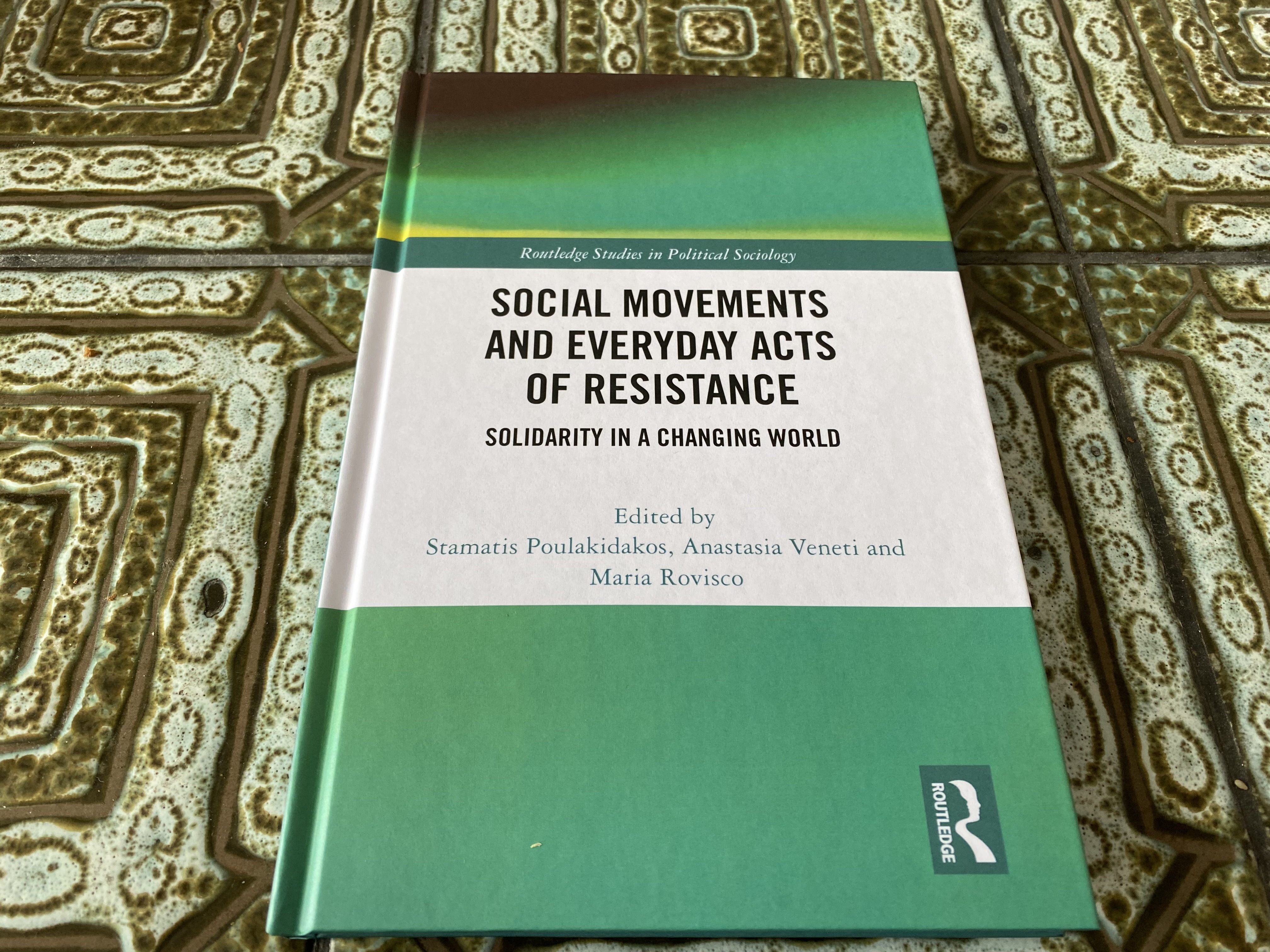
Many thanks to Stamatis, Anastasia and Maria for the invitation to participate and their hard work in pulling together such a great book on social movements and activism.
The book can be ordered here. If you would like a preprint copy of our chapter then please contact me (paul.reilly@glasgow.ac.uk).
Last week I attended an event in Glasgow marking twenty five years of the Good Friday Agreement. There were vivid recollections from former Ulster Unionist Party leader Mike Nesbitt about his experiences as a journalist reporting on the talks at Castle Buildings from the car park outside. Professor Monica McWilliamsrecounted the sexism and misogyny experienced by members of the NI Women’s Coalition both during and after the negotiations. However, it was former SDLP leader and Deputy First Minister Mark Durkan’s reflections on how social media creates a cycle of ‘reacting to reactions’ that particularly resonated. He suggested that it would have been much harder to achieve the Good Friday Agreement in the context of the polarised political debates on social media today.
Yet it would be premature to suggest that online platforms have no potential to promote reconciliation in societies transitioning out of conflict. I found that the most significant peacebuilding contribution of social media was its empowerment of citizens to correct misinformation and disinformation that had the potential to generate sectarian violence. Such false information appeared to have a relatively short lifespan, due in no small part to the fact that tweeters had corrected them and professional journalists had chosen not to share these social media posts in their coverage of these events. Furthermore, it was apparent that much of the social media activity followed contentious parades and protests with little evidence it was directly influencing events on the ground. While it might be convenient to blame platforms like Facebook and Twitter for intercommunal violence, it was the context in which they were used that shaped the interactions between members of rival communities. During periods of political instability the publics mobilised on social media can both help and hinder efforts to moderate sectarian tensions in these contexts.
Would the peace process of the mid-nineties have been possible in the social media era? Certainly it would appear more difficult to keep negotiations private. Journalists like Nesbitt are no longer left outside in the car park looking in. Those within Castle Buildings would also have been subject to much online hate speech, misinformation and trolling by those who opposed the peace process. Yet, it does a disservice to those who negotiated the Agreement to believe that it would have been derailed by such online chatter and noise. While acknowledging the imperfect nature of the Agreement, Monica McWilliams suggested that the leaders of the main parties had the courage not only to compromise but also to explain why they had done so to their respective communities. Fast forward to 2023 and relations between the two largest parties, the Democratic Unionist Party and Sinn Fein, remain fractious. Both have collapsed the powersharing institutions at various points in the past decade; most recently, the DUP have refused to take their seats in the Executive unless the Northern Ireland Protocol and the so-called ‘Irish Sea Border’ created by the UK’s EU Withdrawal Agreement are removed. The politicisation of issues such as a proposed Irish language act has reverberated online as supporters of these parties engage in whataboutery and accuse each other of bad faith. Perhaps the current generation of political leaders need to heed the words of Nobel Peace Prize winner John Hume:
Media and Conflict Memory: an Interdisciplinary Workshop
University of Glasgow, 22-23 November 2023.
Media are integral to how we both remember and forget conflict. While individuals refer to the family photo album, the collective memories of communities are often shaped by iconic photographs of traumatic events such as popular uprisings, terrorist attacks, and wars. This memory work was traditionally confined to repositories such as historical archives, museums and institutions. In recent years the ‘connective turn’ has ‘unmoored’ memory from these institutions, replacing traditional notions of collective memory with the searchable ‘memory of the multitude’ online (Hoskins, 2017). The automated systems of online platforms like Facebook ‘dig’ for memories on behalf of their users, including those of (Jacobsen and Beer, 2021). Historical photographs shared on photo sharing sites like Instagram facilitate informal learning about events such as the Holocaust among younger generations (Commane and Potton, 2019). This has empowered a new generation of memory activists who leverage the affordances of online platforms for commemoration rituals (Fridman, 2022). More recently, apps like Telegram have made it easier to document human rights violations during the Russian invasion of Ukraine, whilst simultaneously creating a curated, unsanitized ‘war feed’ for global audiences (Hoskins and Shchelin, 2023).
This hybrid workshop seeks to advance the discussion about the role of media in conflict memory work. We adopt a purposefully broad definition of conflict which includes (but is not limited to) armed insurrections, civil disorder, geopolitical interstate conflict, political violence in divided societies, terrorist attacks, and wars.
We are looking for original and creative contributions that demonstrate the broad range of methodologies (e.g. qualitative, quantitative, digital) in this emergent field. Abstract submissions should explicitly address the role of media (e.g. newspapers, social media, television) in conflict memory. We will accept both theoretical and empirical studies provided they are relevant to the workshop’s key themes.
Possible topics for the workshop include:
Conflict memory, media and education
Mediatization of war, terrorism, armed conflict and civil disorder
Journalistic practice and collective memories of conflict
Media and conflict memory in post and neo-authoritarian societies
Memory activism after conflict
Radio, memory and conflict
Social media and conflict memory
Television news and audience understanding of conflict
We especially encourage submissions from early career researchers and those based in Global South countries. There will be a limited number of travel bursaries available for those traveling to Glasgow to attend in-person.
Abstracts of 300-500 words, excluding references, should be sent to paul.reilly@glasgow.ac.uk and virpi.salojarvi@helsinki.fi. Please indicate on your submission whether you will attend in-person or online, and if you wish to be considered for a travel bursary should your abstract be accepted. There will be no registration fee for participants accepted for the workshop. Workshop participants will be invited to submit an abstract for a co-edited volume based on the workshop.
For further information on the study, please feel free to contact us.
The abstract can be read below:
Where exactly is the Global South? Exploring Northern visibilities in digital activism research
The seemingly global nature of hashtag activism makes it difficult to assess what regions are being studied in digital activism research and the extent to which this scholarship is subject to ‘digital bias’ (Marres, 2017). This is of particular concern to scholars who have problematised the dominance of ‘Western’, Global North actors in digital media research whilst also calling for internet research methods to become de-westernised, internationalised, or decolonised (e.g. Badr & Ganter, 2021; Bosch, 2022; Milan & Treré, 2019; Karam & Mutsvairo, 2022; Mutsvairo, 2019; Schoon et al., 2020). While some argue that a ‘decolonial turn’ in digital media research is belatedly occurring (Couldry and Mejia, 2021), questions remain about whether similar trends are evident in digital activism research.
In response to this issue, this paper explores geographic representation in digital activism research. The corpus for the systematic review was created by running queries spanning 21 relevant keywords describing digitally enabled activism on the Scopus database. The final corpus consisted of 315 articles published between 2011 and 2018, which was tested on a range of attributes including methodological approaches and factors for evaluating regionality with a focus on regionally disadvantaged communities (towards capturing “Global South” and semi-periphery regions), incl.: case study origin and location, author affiliation, regional foci of the publishing journals, and researched digital/ social media platform (as tied to specific user demographics).
Results indicate that Global North and non-region specific campaigns dominated digital activism research during this period, particularly in articles featuring digital data. As such, extant research in the field has disproportionately produced what we term Northern Visibilities – privileged demographics & popular platforms of the “Global Majority” (i.e. Global North and privileged economies), above all in research applying software-based approaches.
The paper concludes by outlining a number of epistemological provocations around the extent to which the methods and methodological instruments researchers choose affect which social groups they capture or potentially omit as demographics may become diffused over multiple spaces and language contexts. Challenges in capturing Global South and semi-periphery communities apply, above all, in computational approaches as these are often based on high visibility as well as the API access options platforms provide. This means that researchers may need to rethink (a) where (e.g. which platform spaces) and how disadvantaged and less visible social groups are represented online, (b) which precise social groups digital social research is meant to capture, (c) gaps in digital activism research, above all in relation to “unheard” groups, as well as (d) what these skewed representations mean for inclusive research practice.
Bosch, T. (2022). Decolonizing Digital Methods. Communication Theory, 32(2), 298-302.
Couldry, N., & Mejias, U. A. (2021). The decolonial turn in data and technology research: what is at stake and where is it heading?. Information, Communication & Society, 1-17.
Karam, B., & Mutsvairo, B. (2022). Decolonising Political Communication in Africa: Reframing Ontologies (p. 254). Taylor & Francis.
Marres, N. (2017). Digital sociology: The Reinvention of Social Research. Cambridge: Polity Press.
Milan, S., & Treré, E. (2019). Big data from the South (s): Beyond data universalism. Television & New Media, 20(4), 319-335.
Mutsvairo, B. (2019). Challenges facing development of data journalism in non-western societies. Digital Journalism, 7(9), 1289-1294.
Schoon, A., Mabweazara, H. M., Bosch, T., & Dugmore, H. (2020). Decolonising digital media research methods: Positioning African digital experiences as epistemic sites of knowledge production. African Journalism Studies, 41(4), 1-15.
I am sure I was not the only one to find this scene (from Channel 4 sitcom Derry Girls) to be particularly poignant. This week marks 25 years since the Good Friday Agreement was signed. I was a student living in Scotland at the time. My memories of April 1998 primarily revolve around the television coverage of the negotiations at Castle Buildings in Belfast. There are too many to mention here but a few stand out. UK Prime Minister’s (in)famous ‘hand of history’ comment after he earnestly told reporters that this was no time for soundbites. Cameras capturing Brid Rodgers hugging SDLP colleagues in the party’s offices in the early hours of the 10 April, signalling that an Agreement had been reached. And of course there was the televised plenary session on 10 April when US Senator George Mitchell announced an agreement had been reached. The rectangular table with the leaders of the main political parties sitting side-by-side (each with their own name card, as if we needed reminding who they were).
The conversation between Erin and Granda Joe captures the optimism and fear of those who voted in the Good Friday Agreement referendum in May 1998. Like many others, I voted via post and my knowledge of the deal was based entirely on information made available to the public via traditional media. There were no ‘hot takes’ on sites like Twitter informing voters about its contents (perhaps a good thing!). Dial-up internet meant that copies of the text could not be circulated freely online. My dad ended up photocopying the entire document and sending it to me in the post (writing on the first page “some light reading for you”, which still makes me laugh when I see it). In the end, it was an easy decision to vote ‘Yes’. The commitment of paramilitaries to abandon their campaigns of political violence in favour of exclusively peaceful means would mean that future generations would not have to experience the trauma and losses of the past.
Fast forward 25 years and the anniversary of the GFA sees Northern Ireland very much at a crossroads. Admittedly ambitious targets to remove all peace walls by 2023 have not been met, albeit they are dwindling slowly. Paramilitary-style attacks continue to blight what remains a deeply divided society. The continued threat from violent dissident republican groups was illustrated by the attempted murder of PSNI Detective John Caldwell last month. Democratic dysfunction remains a defining feature of the powersharing institutions created under the Agreement. The consociationalist framework of governance means that either of the two largest political parties have the ability to collapse the institutions when it is politically expedient for them to do so. Most recently, the Democratic Unionist Party has boycotted Stormont in protest at the ‘Irish Sea Border’ created by the UK’s EU Withdrawal Agreement. Despite claims from UK Prime Minister Rishi Sunak that the Windsor Framework will make the region the “world’s most exciting economic zone”, it remains to be seen whether it will be enough to convince the DUP to go back into government. SDLP leader Colum Eastwood has argued that the real issue is that they do not want to serve under a nationalist First Minister, a likely scenario given that Sinn Féin are now the largest party in the Assembly.
While it may be imperfect, perhaps even unpalatable for some, these are grounds for optimism. The structures that kept the main communities apart are slowly being dismantled. Research shows an increase in the number of mixed relationships and people who self-identify as neither unionist or nationalist. Activism in areas such as women’s reproductive rights continues to transcend sectarian boundaries. A clear majority of Catholic and Protestant residents living in the vicinity of peace walls want them to come down. Moreover, there are the number of lives saved due to the end of the conflict. Former Sinn Fein President Gerry Adams recently argued there are thousands of people alive today because of the GFA. Now, more than ever, we need political leaders with the bravery of the class of 1998 to protect their hard-won peace.
Semra Demirdis, Stefania Vicari and I have had an article published on how Twitter was used to mobilise hashtag publics during the July 2016 ‘coup’ in Turkey. Based on Serra’s recently completed PhD, we found that the microblogging site was used to promote government propaganda during these events, with frequent calls being made for citizens to protect Turkish democracy or side with the ‘enemies of the nation’. Many thanks to First Monday for publishing this piece and congratulations to Semra on her first publication!
I have written a piece for VIEWdigital on the online abuse experienced by public figures in Northern Ireland. I argue that we need to hold social media users accountable for their actions rather than focus on ending online anonymity. Interventions such as counter-speech campaigns can be effective tools for creating a more civil online discourse.
Many thanks to Brian Pelan and Una Murphy for the opportunity to write about this issue. The piece can be read here.
Please do consider supporting VIEWdigital (print subscriptions cost as little as £40 per year).Further details on how to subscribe can be found here.
I have written a piece for VIEWdigital on the issue of regulating online hate speech. I argue that the publish then filter model of platforms like Facebook and Twitter is partially responsible for the growth in hate speech online. I discuss how national governments and the EU have used fines in an effort to compel these platforms to remove such harmful content. However, if we want to take online harms more seriously we need to treat online platforms like publishers.
Many thanks to Brian Pelan and Una Murphy for the opportunity to write about this issue. The piece can be read here.
Please do consider supporting VIEWdigital (print subscriptions cost as little as £40 per year).Further details on how to subscribe can be found here.





 Dr Paul Reilly