Yesterday, I delivered a presentation at a symposium. The symposium, Leading Curriculum and Assessment Innovation, was organised by the University of Glasgow’s Teaching Excellence Network.
My presentation was titled ‘ Is a dissertation the best way to assess international students? Developing the MCS Independent Research Project’. I discussed the challenges I faced developing and implementing the IRP over the past few years. These challenges ranged from training staff and students to the workload implications of adopting this new model.
Thanks to Julia, Honor and Errol for organising the symposium, and the other participants for their inspiring contributions.
I have an entry in the Elgar Encyclopedia of Political Communication, which was published this week.
In ‘Belief Echoes’, I explore how and why people continue to believe false information. This occurs even when the information has been debunked or fact-checked. I draw on examples from my own research on Northern Ireland and the COVID-19 pandemic. These examples show that a small proportion of the population often remain within epistemic bunkers. These bunkers revolve around misinformation and half-truths.
Many thanks to the editors (Alessandro Nai, Max Grömping, and Dominique Wirz). They worked hard to bring together the 430+ entries from 570+ authors in the Encyclopedia.
The preprint version of my entry can be read here.
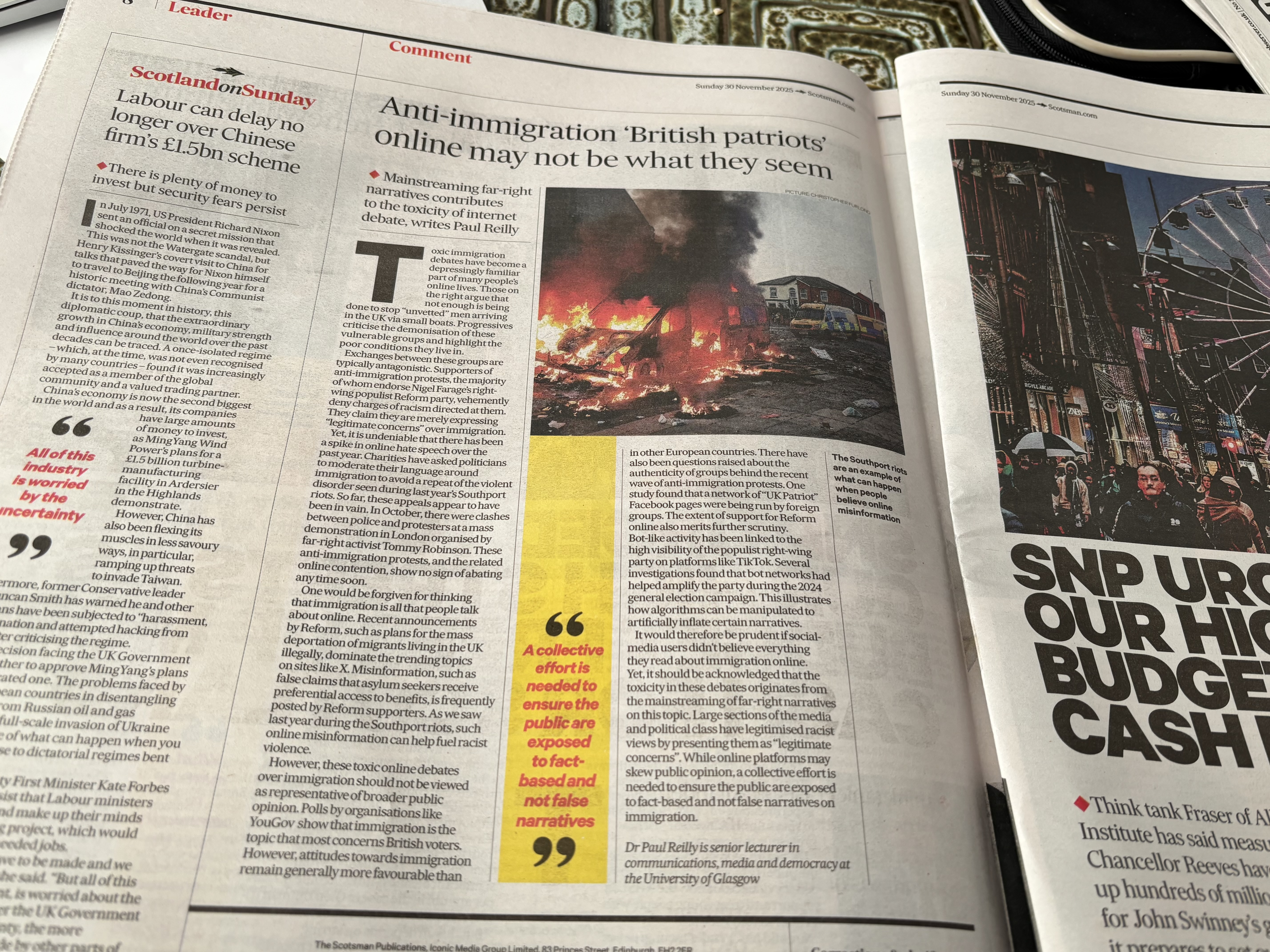
Yesterday I had an op-ed published in Scotland on Sunday. I discussed the toxic immigration debates on social media and the rise of Nigel Farage’s Reform party online. My argument was that we should be more sceptical of what we see online. There is already evidence that bots are used to amplify Reform’s talking points on this issue. The public is apparently obsessed with ‘small boats’ and ‘illegal immigration’. This is due to years of mainstreaming far-right narratives on this topic. I conclude with the argument that a collective effort is required. This effort must ensure that social media users are exposed to facts. It is essential they are not misled by false narratives on immigration.
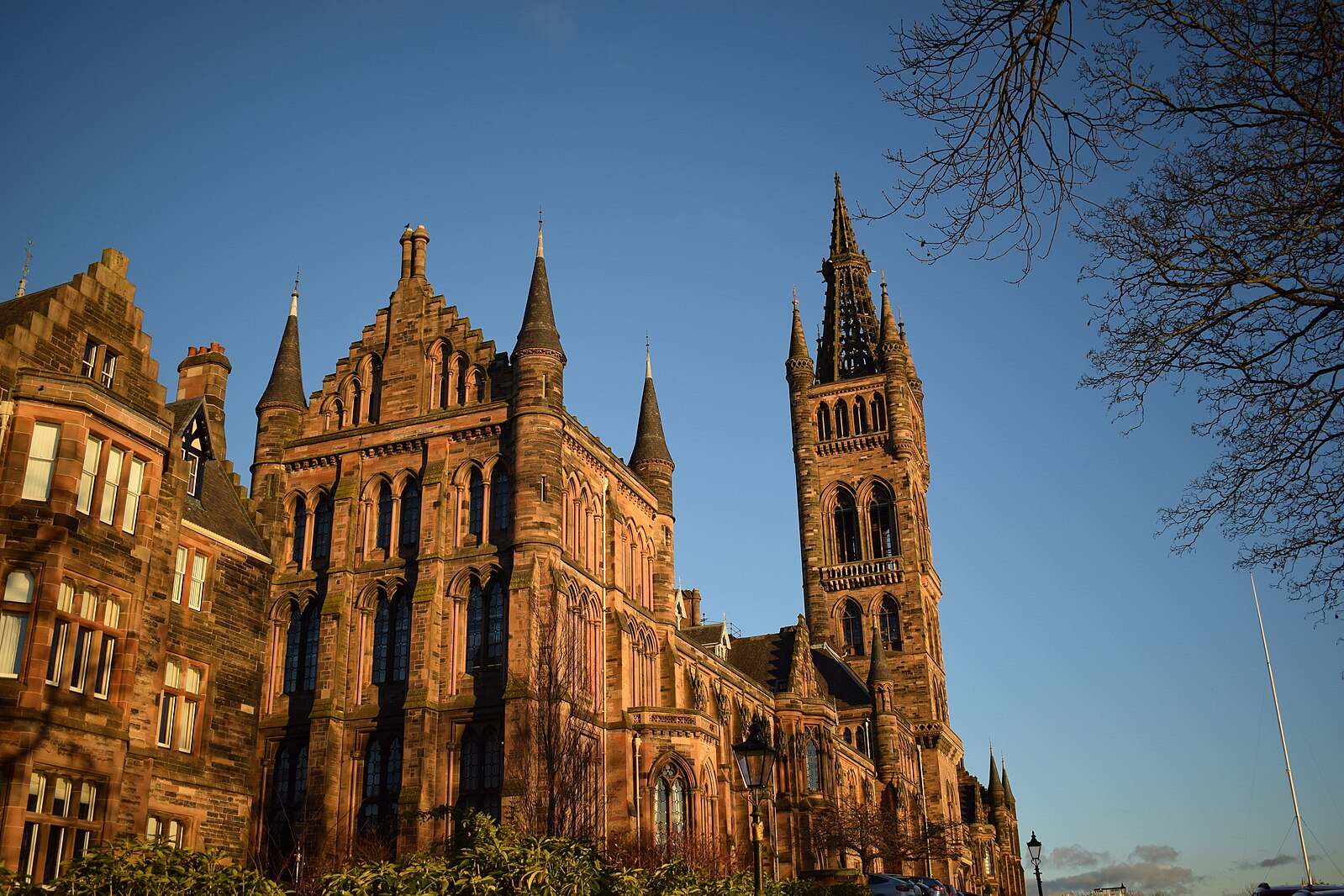
Photo by Clem_nat reproduced by Creative Commons Attribution-Share Alike 4.0 International
Yesterday I was delighted to hear that the Media Research Methods team had received the Teaching Team Award. This was part of the annual School of Social Sciences Learning & Teaching Awards. It recognises excellence in teaching at the University of Glasgow. I was one of 19 colleagues to get this the award (the full names are listed below).
The award committee noted:
“Team teaching is not new our school, but we have recently seen bigger and bigger teams coming together to develop core courses for our largest programmes. The challenge for team delivered courses is the ability to ensure coherence of experience for all students. This is something that the event winners of this award certainly achieved over the past year. Responsible for the largest single course in the school, the judging committee noted that the Media Research Methods team delivered an outstanding first run of a complex, large-scale course, driven by effective collaboration, care, and a shared commitment to over 460 students success”.
I would like to congratulate the rest of the team for all their hard work last year. I want to especially acknowledge Harvey and Lluis for their work convening this course. The full list of recipients is below- congratulations to all!:
Lluis de Nadal Alsina, Harvey Humphrey, Kirstie Ken English, Catriona Forrest, Catherine Happer, Isaac Hoff, Hayes Mabweazara, Ida Norberg, Galina Oustinova-Stjepanovic, Paul Reilly, Cairsti Russell, Lito Tsitsou, Erdem Avsar, Emma Flynn, Adnan Hossain, Caroline Leicht, Ashli Mullen, Yu Sun, Kenneth Ward
I spoke about my ongoing research on social media, parades and protests in Northern Ireland (2012-current). I drew on the results of my book (Digital contention in a divided society), #Brexitriots study, and encyclopedia entry on belief echoes. I discussed how online platforms amplify mis-and disinformation that undermine community relations during contentious events.
This week I was at Edinburgh Napier University to attend the annual MeCCSA conference. The theme this year was ‘Identity and Belonging’, with a specific focus on how identities are mediated and mediate themselves.
First, I was part of a Glasgow University Media Group panel on the Cost of Living Crisis. I presented an overview of the key findings with Cairsti Russell and Gavin Hawkton (unfortunately Catherine Happer was unable to join us due to ill-health).
Key themes included the debate over the use of the word ‘crisis’. There was also a focus on the impact of austerity and cuts in public services on low-income households. Our results suggest that media coverage of the COLC prioritised business perspectives over those of civil society. Citizens are increasingly attracted to alternative news sources. The slides from the session can be viewed below:
These findings are from the GUMG’s forthcoming book ‘Bad News for the Cost of Living Crisis’. The book, edited by Catherine Happer, Alison Eldridge and me, will be published with Palgrave Pivot in December 2025.
My second paper was on my ongoing research on social media, parades and protests in Northern Ireland. I drew on my book Digital Contention in a Divided Society and article on #Brexitriots in my presentation. It explored hashtags as affective ritualised responses to contentious events in Northern Ireland. I examined who was behind these discursive formations online, and who benefited from this activity. The slides can be viewed below:
John Coster (Documentary Media Centre) interviewed me last week for series 2 of #10DaysofConflictMemory.
We discussed my experiences walking the Green Line in Nicosia, Europe’s last divided capital city. Last year, I wrote a piece on this topic. It contained some reflections on walking across the buffer zone, between the Greek Cypriot south and Turkish north of the city.
We discussed the origins of the Green Line before the 1974 invasion. We also compared it to other divided cities like Belfast and Berlin. Additionally, we talked about the dark tourism linked to abandoned settlements.
Thanks to John as always for the invitation. Please do check out the other videos in the series here.
Yesterday I had an op-ed published in the Herald (Glasgow). It discusses the racist rioting seen in Northern Ireland earlier this month.
I argued that politicians have to take responsibility for their role in producing a toxic political discourse about immigration. In towns like Ballymena and Larne, there was violence. Politicians framed anti-migrant demonstrations as representing the ‘legitimate concerns’ of local communities. Now, more than ever, we need a fact-based narrative on immigration. It should be anti-racist to prevent a repeat of these racist riots.
Many thanks to Charlotte Morris and the Herald for arranging this. The op-ed can be read in full here.
The focus of my talk will be on how to publish monographs as an early career researcher. I will provide some advice on how to convert PhD theses into books, including things to include in the proposal and how to write for audiences outside academia.
There will also be a Q&A for ECRs to ask questions about topics such as balancing research and teaching, building international research collaborations, and maximising the impact of research.
Many thanks to Jun Liu (University of Copenhagen) and Yu Sun (University of Glasgow) for the invitation.
My article ‘The Blame Game? #Brexitriots as an affective ritualized response to civil disorder in Northern Ireland has been published in the International Journal of Communication.
This paper focuses on how the April 2021 violence in Northern Ireland were discursively framed on Twitter. I argue that #Brexitriots was an affective ritualised response to civil unrest in Northern Ireland. It demonstrated a lack of knowledge of the grievances fuelling this violence.
The abstract is below:
The protests and violence in Northern Ireland in April 2021 were nominally a manifestation of Loyalist anger at the “Irish Sea border” created as part of the deal that saw the United Kingdom leave the European Union. Social media were widely blamed for having amplified tensions surrounding the protests. This study explores how affective publics, mobilized on Twitter, responded to the “Brexit riots.” It does so by providing an overview of how online platforms are used during contentious episodes in divided societies, examining the background of the disorder, and presenting the results of a reflexive thematic analysis of #brexitriots tweets (N = 8287) posted between April 9 and April 13, 2021. Results indicate that #Brexitriots was an affective ritualized response from tweeters who appeared unaware of the manifold grievances of the protesters. They used these events as a source of partisan political expression, confirming their view that the United Kingdom’s departure from the European Union was a mistake.
I would like to thank Suay Özkula and Victoria Baskett for their feedback on an earlier draft of this study. Also, a special mention to Kady and the IJOC team for their editorial help.
The paper is published Open Access and can be read in full here