I have an entry in the Elgar Encyclopedia of Political Communication, which was published this week.
In ‘Belief Echoes’, I explore how and why people continue to believe false information. This occurs even when the information has been debunked or fact-checked. I draw on examples from my own research on Northern Ireland and the COVID-19 pandemic. These examples show that a small proportion of the population often remain within epistemic bunkers. These bunkers revolve around misinformation and half-truths.
Many thanks to the editors (Alessandro Nai, Max Grömping, and Dominique Wirz). They worked hard to bring together the 430+ entries from 570+ authors in the Encyclopedia.
The preprint version of my entry can be read here.
Virpi Salojärvi (University of Helsinki/University of Vassa) and I are pleased to announce the publication of our co-edited book (De)constructing societal threats during times of deep mediatization today. A description of the book can be found below:
This book explores how both elite and non-elite actors frame societal threats such as the refugee crisis and COVID-19 using both digital and traditional media. It also explores ways in which the framing of these issues as threatening can be challenged using these platforms.
People typically experience societal threats such as war and terrorism through the media they consume, both on and offline. Much of the research in this area to date focuses on either how political and media elites present these issues to citizens, or audience responses to these frames. This book takes a different approach by focusing on how issues such as the refugee crisis and the COVID-19 pandemic are both constructed and deconstructed in an era of hybrid media. It draws on a range of traditional and innovative research methodologies to explore how these issues are framed as ‘threats’ within deeply mediatized societies, ranging from content analysis of newspaper coverage of the Macedonian name dispute in Greece to investigating conspiratorial communities on YouTube using Systemic Functional Linguistics. In doing so, this book enriches our understanding of not only how civil and uncivil actors frame these issues, but also their impact on societal resilience towards future crises.
(De)constructing Societal Threats During Times of Deep Mediatization will be a key resource for academics, researchers, and advanced students of Communication Studies, Media Studies, Journalism, Cultural Studies, Research Methods, Sociology and Politics.
The chapters included in this book were originally published as a special issue of The Communication Review. Many thanks to our authors for their excellent contributions, which are listed below:
1. Framing the Macedonian name dispute in Greece: Nationalistic journalism and the existential threat Minos-Athanasios Karyotakis
2. The “ultimate empathy machine” as technocratic solutionism? Audience reception of the distant refugee crisis through virtual reality Zhe Xu and Mengrong Zhang
3. A systemic functional linguistics approach to analysing white supremacist and conspiratorial Ddscourse on YouTube Olivia Inwood and Michele Zappavigna
4. Internet regulation and crisis-related resilience: From Covid-19 to existential risks Gregory Asmolov
uVIEWdigital op-ed on future of local journalism, 25 May 2021
I have an op-ed in VIEWdigital this week, which focuses on how to future-proof journalism after the COVID-19 pandemic.
Drawing on my testimony to a hearing organised by the Council of Europe Parliamentary Assembly Committee on Culture, Science, Education and Media, my recommendations on how to improve media coverage of crises include:
1) Impose harsher penalties on social media companies for failing to remove misinformation and disinformation from their sites.
These could range from punitive fines to more radical measures such as recognising social media companies as media publishers.
2) Prioritise source criticism over objectivity in journalism.
False balance approaches that amplify inaccurate, unverified claims should be avoided. This approach should be implemented alongside existing factchecking initiatives (e.g. Full Fact) to counteract misinformation and disinformation during crises.
3) Protect public service media from government interference.
It is imperative that the editorial independence of these organisations is maintained in the future.
4) Provide financial support to the hyperlocal sector
Hyperlocal news sites should be given financial support from governments in order to reduce their reliance on digital advertising. For instance, the National Union of Journalists News Recovery Plan proposes that tax credits and interest free loans be provided to these outlets in order to ensure their sustainability.
5) Promote solutions journalism as a counterpoint to ‘snackable’ news coverage.
While there remains a need for more empirical evidence showing its impact on behaviour, solutions journalism is a corollary for encouraging citizens to think of collective rather than individual interests during these incidents.
This is by no means an exhaustive list but it would be a start. As I argued previously, we should all do what we can to support local journalists, the ‘first responders’ during crises like the pandemic.
Thanks to Brian and Una for the opportunity. The piece can be read in full here
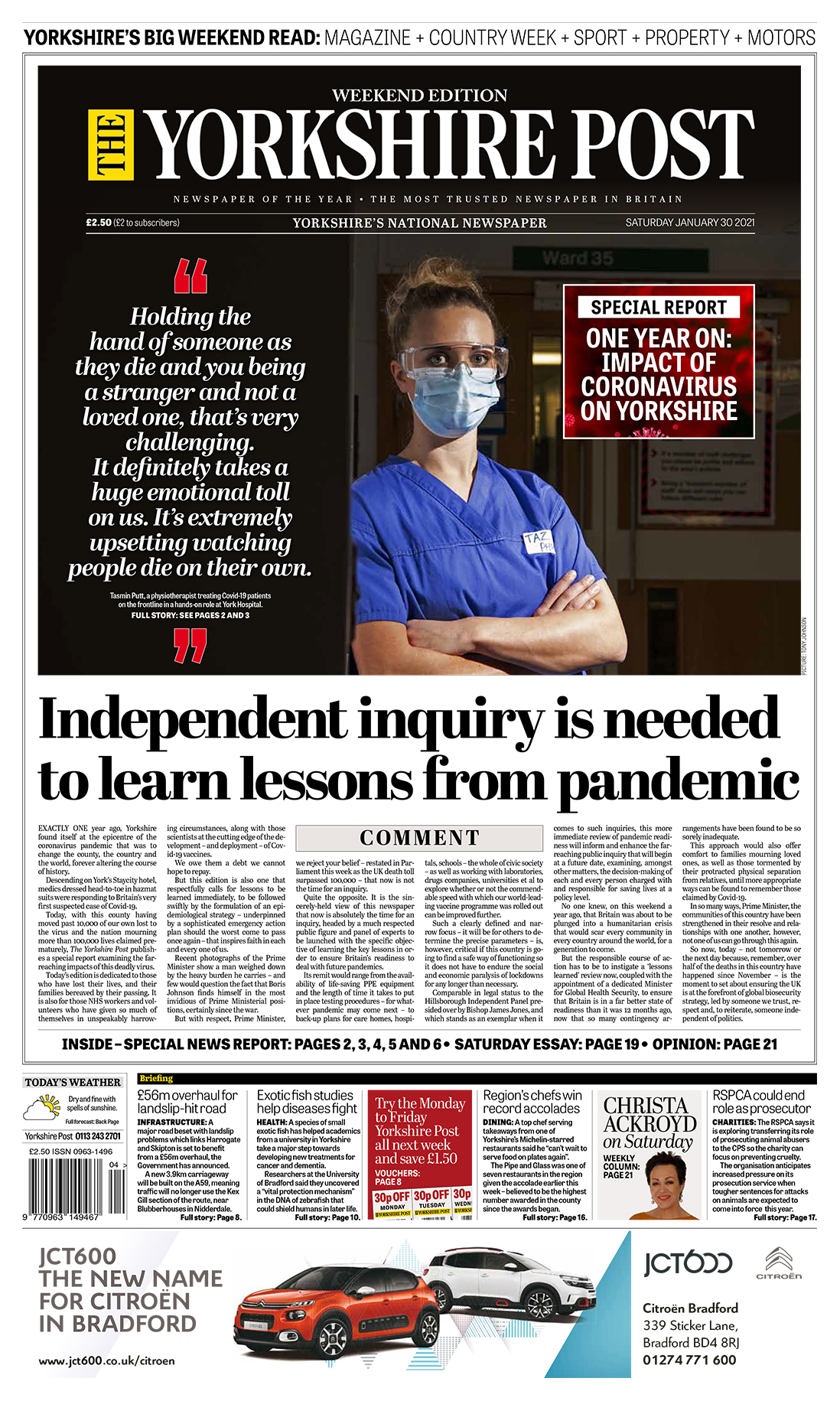
Yorkshire Post special issue on COVID-19, 30 January 2021.
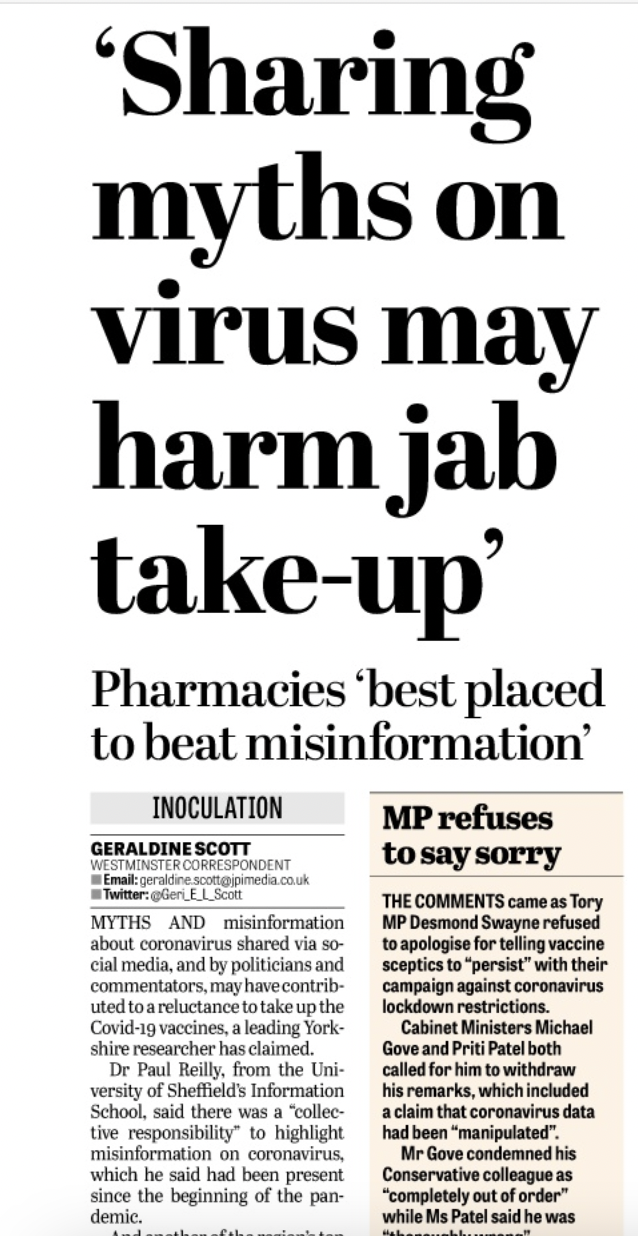
I was interviewed last week for an article that appeared in Saturday’s edition of the Yorkshire Post. As part of their special news report to mark the anniversary of the COVID-19 pandemic, I was asked to comment on the impact of misinformation on vaccine hesitancy, and the reasons why people may believe false information about the virus and its treatment.
Article on misinformation and impact on vaccine take-up
The article can be read here. Many thanks to Geri Scott for her time and the interview.
I have had an article published in the most recent edition of France Forum. I argue that we all have a responsibility to verify information about COVID-19 before we share it online. I also suggest we should be wary of the misinformation about the pandemic shared by politicians, which has the potential to hamper efforts to flatten the curve.
Many thanks to Marc Foucault and Elisabeth Cazeaux for the invitation to write this piece. An English language version can be read below.
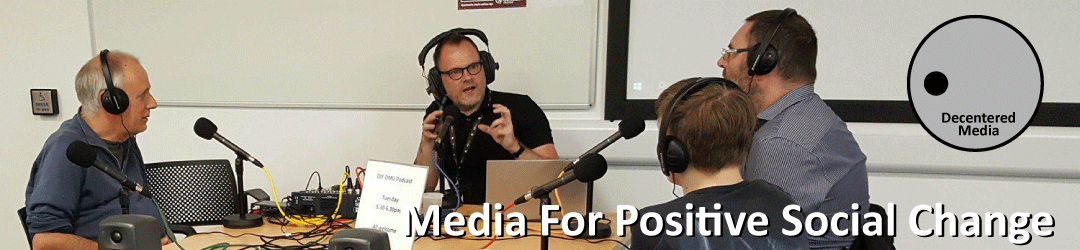
Yesterday I was in conversation with Rob Watson for the Decentered Media Podcast. We discussed what lessons we can learn from the public health communication campaigns during the pandemic, the future of local journalism, and the ways in which communities can be empowered during future crises. Many thanks to Rob for the opportunity.
I have written a short blog for Supervising PGRs on the challenges of supervising PhD researchers during the pandemic. The key takeaway is the need for supervisors to be kind, supportive and responsive to PGRs during a time in which we are all experiencing stress and anxiety. Many thanks to Kay Guccione for the opportunity. Please do check out her other work on mentoring, which i have found incredibly helpful in the past.
Yesterday Cormac Lawler I took part in a podcast hosted by Rob Watson focussing on wellbeing and media during the COVID-19 lockdown. We discussed a wide variety of issues including what type of future awaits local journalism as we come out of the pandemic. Rob runs the excellent Media for Positive Social Change , which has some great podcasts, blogs and other resources about community media.
Many thanks to Rob for the invitation, and to him and Cormac for a really enjoyable chat!





 Dr Paul Reilly